What metaheuristics are, and when to use one
A metaheuristic is a general-purpose search strategy for finding a good
solution to an optimization problem when you can only evaluate candidate
solutions — call a function f(x) and get a number back — and cannot rely
on any special mathematical structure of f (differentiability, convexity,
linearity, ...). This is often called black-box optimization: the
optimizer never sees f's formula, only its outputs.
Why not an exact or gradient method?
Two large families of optimization methods exist alongside metaheuristics, and each needs something a black-box problem usually cannot give it:
- Exact methods (branch and bound, linear/integer programming, dynamic programming) guarantee the true optimum, but need exploitable structure — convexity, linearity, a small enough discrete state space — and their worst-case running time is often exponential once that structure is gone.
- Gradient-based methods (gradient descent, quasi-Newton, ...) are fast
and precise, but need
fto be differentiable (and, in practice, for the gradient to be cheap to obtain). A simulation, a black-box scientific model, a combinatorial objective (a tour length, a schedule's makespan), or a noisy measurement usually offers no gradient at all.
A metaheuristic asks for none of that. It only needs to call f(x) and
compare the numbers that come back. The price is that it offers no
optimality guarantee — it searches, it does not solve — and its currency is
the evaluation budget: the total number of times f may be called
before the search must report its best answer. Every sezgi algorithm's
run(..., budget=...) argument is exactly this currency.
No free lunch, stated honestly
Wolpert & Macready's "No Free Lunch" theorems (1997) show that, averaged over every possible objective function, no optimizer outperforms any other — including plain random search. This is not a discouraging trivia fact; it is a warning against algorithm-shopping by reputation. A metaheuristic's performance on the problems you actually care about is an empirical question, not a theoretical one, and it must be answered by running the algorithm on your problem (or a representative benchmark) under a fixed budget and comparing honestly — the subject of Comparing algorithms fairly.
Two algorithms, the same problem, the same budget
Both sezgi.RandomSearch and sezgi.DifferentialEvolution are wrapper
classes over the exact same underlying engine (see
Engine flow); they differ only in how they
turn the current population into new candidates.
import sezgi

problem = sezgi.bbob(1, 5, 1)  # BBOB f1 (Sphere), dim=5
budget, seed = 1000, 1

rs = sezgi.RandomSearch(pop_size=20).run(problem, budget=budget, seed=seed)
de = sezgi.DifferentialEvolution(pop_size=20).run(problem, budget=budget, seed=seed)

print(f"random_search:        best_f={rs.best_f:.6g} gap={rs.gap:.6g}")
print(f"differential_evolution: best_f={de.best_f:.6g} gap={de.gap:.6g}")
random_search: best_f=-121.657 gap=4.29229 differential_evolution: best_f=-125.949 gap=0.000359204
RandomSearch (presets.rs's random_search — uniform resampling every
generation) has no mechanism to concentrate search near good points;
DifferentialEvolution does (it perturbs candidates using the difference
between other population members). On this one seeded run, the difference
is visible in the printed gap — but one seeded run is an illustration,
not evidence: see page 5 before drawing any conclusion from a result like
this one.
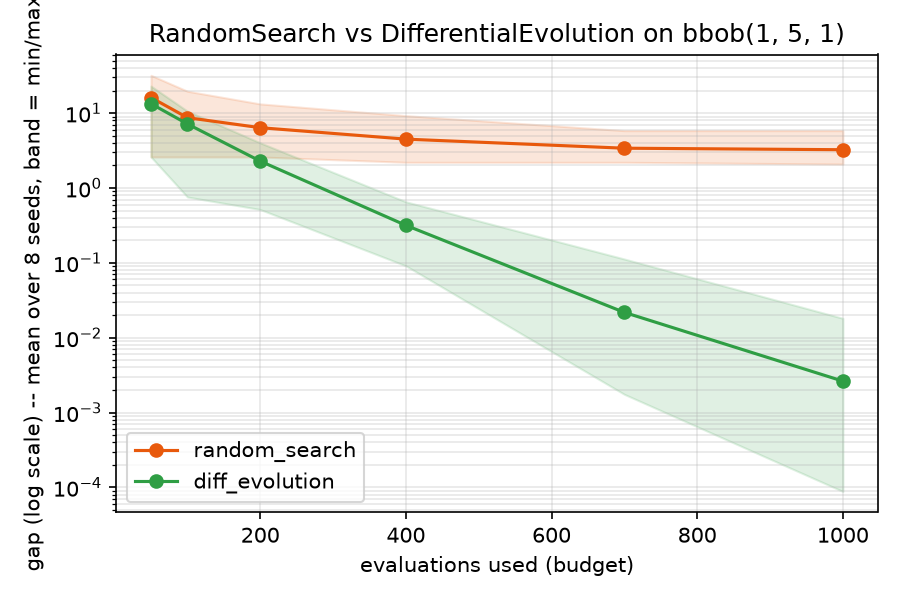
The same comparison, over several seeds
A single seeded run above is only an illustration. The figure below runs the same two algorithms on the same problem across 8 seeds each, at six increasing budgets, plotting the MEAN gap with a shaded min/max band — the first place on this site a reader sees run-to-run spread drawn directly, before page 5 introduces a real statistical test for it:
The decision, as a diagram
flowchart TD
    F["Objective f(x)"] --> Q1{"Differentiable\nand cheap to\ndifferentiate?"}
    Q1 -->|yes| GRAD["Gradient-based method\n(SGD, quasi-Newton, ...)"]
    Q1 -->|no| Q2{"Exploitable structure?\n(convex, linear,\nsmall discrete state space)"}
    Q2 -->|yes| EXACT["Exact method\n(branch and bound, LP/IP, DP)"]
    Q2 -->|no| Q3{"Can you afford a fixed\nbudget of f(x) calls?"}
    Q3 -->|yes| META["Metaheuristic\n(sezgi: RandomSearch, DifferentialEvolution,\nGeneticAlgorithm, ParticleSwarm, ...)"]
    Q3 -->|no, f is too expensive| SUR["Surrogate/model-based search\n(outside sezgi's current scope)"]

    subgraph sezgi["What sezgi's Engine::run actually does with a metaheuristic"]
      SPEC["Preset spec\n(sezgi.presets.random_search / de_rand_1 / ...)"] --> ENGINE["Engine::run\n(one shared loop, crates/core/src/engine.rs)"]
      ENGINE --> RESULT["RunResult\n(best_f, best_x, evals_used)"]
    end
META --> SPECNext
- Anatomy of a population-based algorithm breaks the generation loop above into its four separable stages.