Encodings and search spaces
Before an algorithm can search anything, a problem author must decide what a candidate solution is — its encoding. This is a modeling decision, not an implementation detail: the same real-world problem can be encoded several different ways, and the encoding determines which operators (mutation, crossover, repair) even make sense.
sezgi's search spaces are built from five block kinds
(crates/core/src/space.rs:13-18, mirrored 1:1 by
py-sezgi/python/sezgi/spaces.py):
| Block | Python builder | Genotype → Python type | Typical use |
|---|---|---|---|
| Continuous | sezgi.Float(lo, hi, n) |
list[float] |
tunable real-valued parameters |
| Integer | sezgi.Int(lo, hi, n) |
list[int] |
counts, discretized parameters |
| Categorical | sezgi.Categorical(k, n) |
list[int] (indices 0..k) |
unordered choices (kernel type, ...) |
| Binary | sezgi.Binary(n) |
list[bool] |
inclusion masks, on/off flags |
| Permutation | sezgi.Permutation(n) |
list[int] (a permutation of range(n)) |
orderings, tours, schedules |
The conversion table above (py-sezgi/python/sezgi/problem.py's module
docstring) is exactly what evaluate(x) receives: a single-block space's
x is that block's own converted value, passed bare; a multi-block space's
x is a tuple of per-block values, in space()'s declared order.
One Problem per encoding shape
import sezgi

continuous = sezgi.bbob(1, 3, 1)
print("continuous:  ", [b["kind"] for b in continuous.blocks()])

integers = sezgi.problems.int_quadratic(lo=0, hi=20, n=4)
print("integer:     ", [b["kind"] for b in integers.blocks()])

categorical = sezgi.problems.cat_match(k=4, n=6, seed=1)
print("categorical: ", [b["kind"] for b in categorical.blocks()])

binary = sezgi.problems.onemax(n_bits=16)
print("binary:      ", [b["kind"] for b in binary.blocks()])

permutation = sezgi.problems.tsp("berlin52")
print("permutation: ", [b["kind"] for b in permutation.blocks()])

mixed = sezgi.problems.mixed_diagnostic(n_float=2, n_int=2, k_cat=3, n_cat=2, n_bin=3)
print("mixed:       ", [b["kind"] for b in mixed.blocks()])
continuous: ['float'] integer: ['int'] categorical: ['categorical'] binary: ['binary'] permutation: ['permutation'] mixed: ['float', 'int', 'categorical', 'binary']
Every one of these is a real, runnable sezgi.Problem handle — none of
them are illustrative stand-ins. The mixed-space handle
(sezgi.problems.mixed_diagnostic) composes four block kinds into one
Space, exactly the way sezgi.Space(Float(...), Int(...), ...) composes
your own blocks.
Why the encoding is not a free choice
The encoding literally selects which operator set an algorithm can use.
sezgi.GeneticAlgorithm auto-dispatches to one of five presets based on
the problem's own block kind — ga_real for all-Float, ga_perm for
all-Permutation, ga_bin for all-Binary, ga_int for all-Int, ga_cat
for all-Categorical (py-sezgi/python/sezgi/builtins.py's
GeneticAlgorithm._resolve_representation) — because a crossover operator
that makes sense on a permutation (order-preserving, no repeated city) is
meaningless applied to an independent-bit binary string, and vice versa. A
multi-block space whose blocks all share one kind auto-dispatches through
gen/compound inside GeneticAlgorithm (one generator copy per block).
A space that mixes block kinds has no single ga_* preset, so
GeneticAlgorithm rejects it. Since 0.1.3 gen/compound
(crates/components/src/compound.rs) accepts any registered generator that
is stateless, pop-to-pop and free of internal evaluation — plus an explicit
allow-list of self-contained stateful generators (currently gen/gsa and
gen/ba since 0.1.5; gen/pso, gen/de-jde and gen/mfo since 0.1.6) — and 17 presets
(DifferentialEvolution rand1/best1 — and, since 0.1.6, jde —
GreyWolfOptimizer,
WhaleOptimization, SineCosineAlgorithm, JAYA,
GrasshopperOptimization, SalpSwarm, FireflyAlgorithm,
FlowerPollination, TLBO, CuckooSearch, and — since 0.1.4 —
AntLion and EvolutionStrategy, and — since 0.1.5 —
GravitationalSearch and BatAlgorithm, and — since 0.1.6 —
ParticleSwarm and MothFlameOptimization) auto-dispatch on a mixed
space to a hybrid: the preset's own generator on float blocks, GA
variation on binary/int/categorical/permutation blocks, with parent
selection and replacement following the preset's own pipeline. A space with
no float block gets zero preset-specific variation (all variation is GA).
import sezgi

class Mixed(sezgi.Problem):
    def space(self):
        return sezgi.Space(sezgi.Float(-5.0, 5.0, 4), sezgi.Binary(6))

    def evaluate(self, x):
        floats, bits = x
        return sum(v * v for v in floats) + sum(1 for b in bits if not b)

# DE varies the float block, GA variation (gen/ga-bin) the binary block.
result = sezgi.DifferentialEvolution().run(Mixed(), budget=2000, seed=7)
Three block kinds, sampled
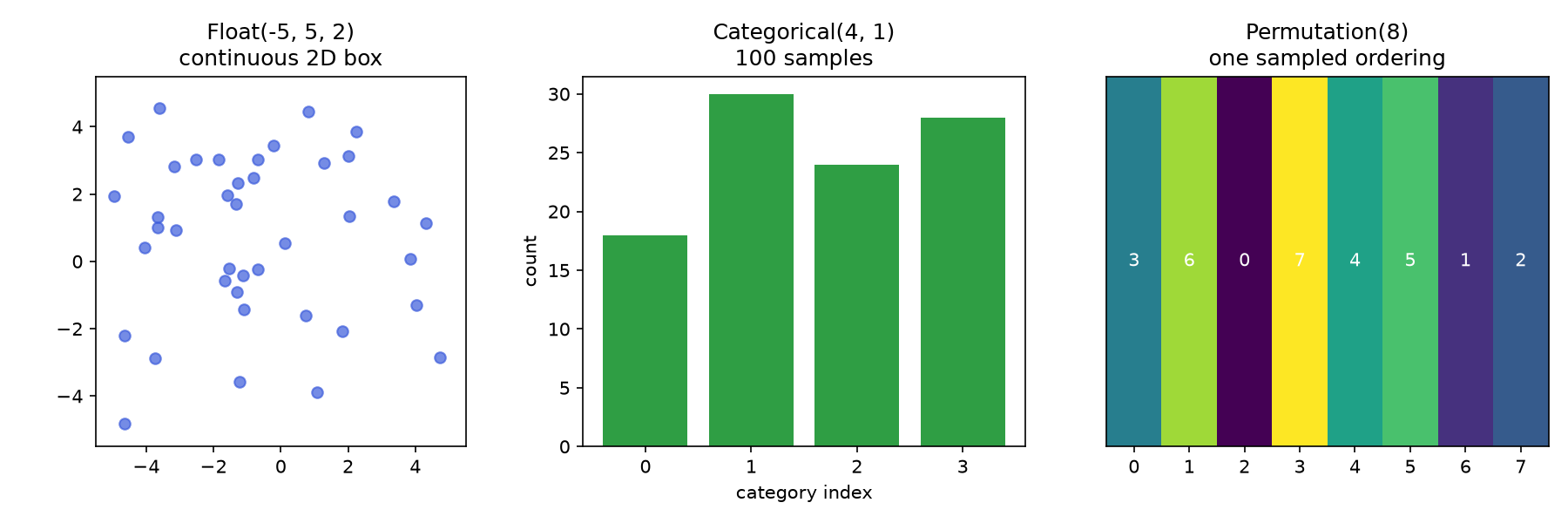
The figure below shows what three of these encodings actually LOOK like,
sampled directly from the engine's own initial-population sampler (the
same init/uniform path every algorithm's run() seeds from, captured
via the generate() hook Tutorial 3 teaches): a continuous Float(-5, 5,
2) box, a Categorical(4, 1) choice sampled 100 times, and one
Permutation(8) ordering:
A composed space, block by block
flowchart LR
    SPACE["Space(Float(-5, 5, 2), Int(0, 9, 1), Categorical(k=3, n=1))"] --> B1
    subgraph blocks["Blocks, in declared order"]
      direction LR
      B1["Float block\nn=2"] --> T1["x[0]: list[float]"]
      B2["Int block\nn=1"] --> T2["x[1]: list[int]"]
      B3["Categorical block\nn=1, k=3"] --> T3["x[2]: list[int]\n(indices 0..3)"]
    end
    B1 --> B2 --> B3
T1 & T2 & T3 --> X["evaluate(x):\nx = (x[0], x[1], x[2])\n-- a tuple, multi-block space"]Next
- Comparing algorithms fairly puts a single run like the ones above into proper statistical context.