Tutorial 7: Multi-objective optimization with NSGA-II
Every tutorial so far returned a SolveResult — one best_x, one
best_f. NSGA-II (Deb, Pratap, Agarwal & Meyarivan 2002) optimizes
SEVERAL objectives at once, where no single point is "best" — instead it
returns a whole POPULATION and marks which members are non-dominated (the
Pareto front). sezgi.NSGA2 is deliberately the one built-in wrapper
class whose .run() does NOT return SolveResult — this tutorial states
that exception plainly and shows exactly what it returns instead.
The result shape exception, stated honestly
sezgi.NSGA2(pop_size=...).run(...) returns sezgi.mo.nsga2's OWN dict
shape verbatim — SolveResult's fields (best_x/best_f/f_opt/gap)
assume a single-objective run with one best point, which does not fit a
multi-objective Pareto front. This is the ONE builtin wrapper class where
.run()'s return type differs from every other class in sezgi.builtins
— not an oversight, a documented design choice (see sezgi.NSGA2's own
class docstring).
import sezgi

result = sezgi.NSGA2(pop_size=40).run("zdt1", 10, 4000, seed=20260830)
print(f"result keys: {sorted(result.keys())}")
print(f"population size: {len(result['individuals'])}")
print(f"front0 size (non-dominated members): {len(result['front0'])}")
print(f"evals_used: {result['evals_used']}")
result keys: ['evals_used', 'front0', 'individuals', 'objectives'] population size: 40 front0 size (non-dominated members): 40 evals_used: 4000
result["individuals"] — one float-list per final-population member (a
Binary block, if present, is flattened to 0.0/1.0 — a DIFFERENT
convention than every other wrapper class's typed best_x, which is a
documented, per-surface choice, not an inconsistency to fix).
result["objectives"] — parallel float-lists, one per objective, per
member. result["front0"] — indices into individuals/objectives of
the non-dominated set. result["violations"] is present only for a
constrained problem (not zdt1).
Reading a Pareto front
import sezgi

PROBLEM = "zdt1"
DIM = 10
POP_SIZE = 40
BUDGET = 4000
SEED = 20260830
REF_POINT = [1.1, 1.1]  # ZDT1's objectives lie in [0,1]x[0,1]; 1.1 dominates the whole front

result = sezgi.NSGA2(pop_size=POP_SIZE).run(PROBLEM, DIM, BUDGET, seed=SEED)
front0_objectives = [result["objectives"][i] for i in result["front0"]]
reference_front = sezgi.mo.pareto_front(PROBLEM, DIM, n=200)

hv = sezgi.mo.hypervolume_2d(front0_objectives, REF_POINT)
igd_value = sezgi.mo.igd(front0_objectives, reference_front)

print(f"problem={PROBLEM} dim={DIM} pop_size={POP_SIZE} budget={BUDGET} seed={SEED}")
print(f"front size: {len(front0_objectives)}")
print(f"hypervolume_2d (ref_point={REF_POINT}): {hv:.6g}")
print(f"igd (vs a 200-point analytic front sample): {igd_value:.6g}")
problem=zdt1 dim=10 pop_size=40 budget=4000 seed=20260830 front size: 40 hypervolume_2d (ref_point=[1.1, 1.1]): 0.858058 igd (vs a 200-point analytic front sample): 0.0125454
sezgi.mo.pareto_front(problem, dim, n) samples n points of the
ANALYTIC known-optimal front (when one exists for this problem family —
None for problems like WFG1/WFG2 with no closed-form front), so
hypervolume_2d (the S-metric: the volume of objective space dominated by
the found front, relative to a reference point — higher is better) and
igd (inverted generational distance: how far the found front is from the
true one — lower is better) both have a ground truth to compare against.
Small budget, single seed, single problem — no cross-algorithm quality
claim is made here either (same policy as every other page on this site).
The front, visually
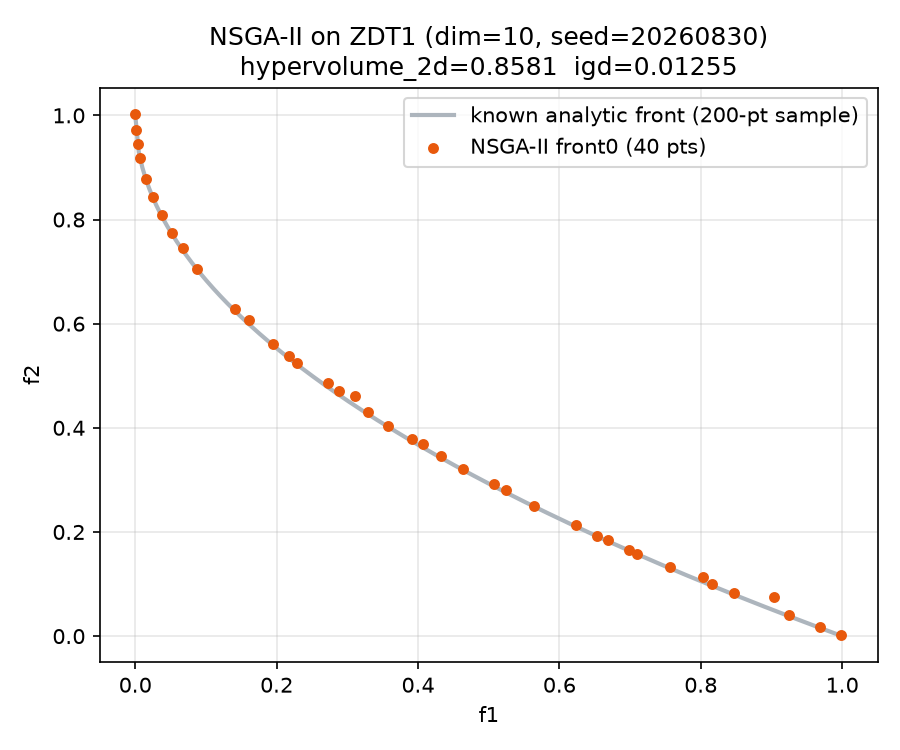
The orange points (the algorithm's own front0) trace the grey analytic
curve closely — the small igd value above is exactly this visual
closeness, quantified.
Why NSGA-II is not authored the sezgi.Algorithm way
Authoring an NSGA-II variant as an engine-hosted Python callback (the way
Tutorials 3-6 author a scalar algorithm's generate()) is explicitly out
of scope for this milestone: NSGA-II's own selection/crossover/replacement
loop is hard-coded Rust, not routed through the
Registry/AlgorithmSpec/Engine/Generator machinery sezgi.Algorithm
targets. sezgi.NSGA2's constructor takes the algorithm-configuration
knobs (pop_size, eta_c, eta_m, p_c, ..., mirroring mo.nsga2's own
parameters); run() takes the per-problem knobs (problem, dim,
budget, m, seed, ...) — together, sezgi.NSGA2(pop_size=P,
**op_kwargs).run(problem, dim, budget, seed=S, ...) is identical to
calling sezgi.mo.nsga2(problem, dim, P, budget, seed=S, **op_kwargs)
directly.
Next
- Comparing algorithms and statistics — back
to single-objective
SolveResults, now compared honestly across many seeds.