Quickstart (Python, class-first)
Every built-in algorithm is a class; every problem is a native handle
(sezgi.bbob(...), sezgi.problems.onemax(...), ...) or a
sezgi.Problem subclass you author yourself. .run() accepts either and
returns the same SolveResult shape across every scalar optimizer
(NSGA2 is the one exception: it returns the multi-objective result
dictionary its own docstring describes).
The 10-line path
This block actually runs at build time (via markdown-exec) — the
output below it is real, not transcribed, so it cannot silently drift
from the code above it.
import sezgi

problem = sezgi.bbob(1, 5, 1)  # BBOB f1 (Sphere), dim=5, instance=1
result = sezgi.GeneticAlgorithm(pop_size=20).run(problem, budget=1000, seed=1)

print(f"evals_used={result.evals_used}")
print(f"best_f={result.best_f:.6g}")
print(f"f_opt={result.f_opt:.6g}")
print(f"gap={result.gap:.6g}")
evals_used=1000 best_f=-125.943 f_opt=-125.95 gap=0.00720258
sezgi.bbob(fid, dim, instance) is a Problem handle for a COCO/BBOB
noiseless function — fid=1 is the Sphere function. GeneticAlgorithm
auto-dispatches on the problem's space kind (here, a continuous Float
space, so it delegates to presets.ga_real internally — see
Built-in algorithm classes). budget is the total
number of objective-function evaluations allowed; seed makes the run
byte-reproducible — the same (problem, budget, seed) always produces
the same result in this build and across the R frontend for a shared
algorithm.
Reading the result
SolveResult (returned by every wrapper class's .run()) carries:
algo— the preset name that actually ran (useful when a wrapper class auto-dispatches, likeGeneticAlgorithmabove).seed,budget,evals_used— the run's own bookkeeping;evals_usedisbudgetunless the algorithm terminates early.best_x,best_f— the best point evaluated and its objective value.best_fis not guaranteed to lie within the problem's declared bounds for every algorithm (seesezgi.solve's own docstring on the Solve / compat internals page).f_opt,gap— the problem's known optimum (Noneif unknown) andbest_f - f_opt.
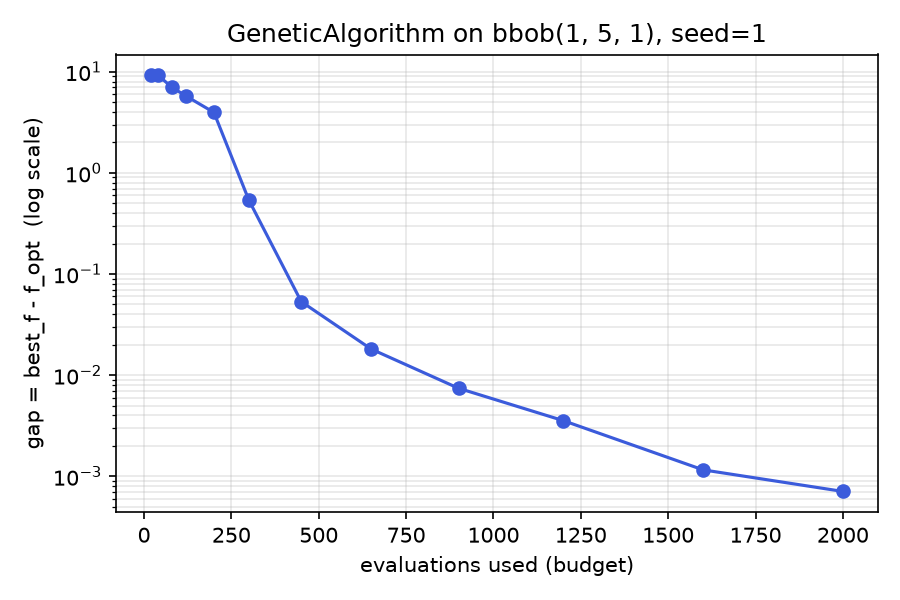
A look at convergence
The 10-line run above, re-run at 12 increasing budgets — same problem,
algorithm, and seed each time, each budget run as its own independent
.run() call. GeneticAlgorithm's generator never reads the total
budget while it runs (unlike budget-adaptive presets such as lshade,
see Determinism and the RNG model), so
an independent run at a smaller budget lands on the same point a longer
run with the same seed would have reached, whenever the two runs
complete the same number of generations — true at 11 of the 12 budgets
plotted here (the one exception, budget=450, stops one partial
generation short of where a longer run's own trajectory stood at
evaluation #450, since the engine only evaluates whole generation
batches):
Your own problem
Subclass sezgi.Problem and implement space() and evaluate(x):
import sezgi

class Sphere(sezgi.Problem):
    def __init__(self, n=3, lo=-5.0, hi=5.0):
        self.n, self.lo, self.hi = n, lo, hi

    def space(self):
        return sezgi.Float(self.lo, self.hi, self.n)

    def evaluate(self, x):
        return sum(v * v for v in x)

result = sezgi.GeneticAlgorithm(pop_size=20).run(Sphere(n=3), budget=500, seed=1)
print(f"evals_used={result.evals_used} best_f={result.best_f:.6g}")
evals_used=500 best_f=0.005517
See Problem and spaces for the full space-builder
table (Float/Int/Categorical/Binary/Permutation, and mixed
spaces via Space(*blocks)).
Next steps
- New to metaheuristics? Start the Learn track — six introductory pages, each with a runnable snippet and a diagram.
- Concepts & architecture for how the engine loop, the Python class hierarchy, and the RNG determinism model actually work.
- API reference for the full auto-generated Python API.
- R surface if you want the same guarantees from R.