Mamdani inference
A Mamdani system (MamdaniFIS) turns crisp
inputs into a crisp output through rules written in words: if service is poor or food
is rancid then tip is cheap. Use it when the knowledge you have is linguistic and you
want an output you can explain rule by rule. The same rule language drives the
Sugeno and Tsukamoto systems and the interval type-2
systems.
The idea
Inference runs in four steps, and every step is a named option of the constructor.
- Fuzzify each crisp input: its membership degree in every term of its variable.
- Fire each rule. The antecedent is combined with
AND(a t-norm) andOR(a t-conorm); multiplying by the rule weight gives the firing strength \(\alpha_k\). - Imply and aggregate. Each rule's consequent set is clipped (or scaled) by \(\alpha_k\), and the clipped sets are combined into one output set.
- Defuzzify the aggregated set into one number.
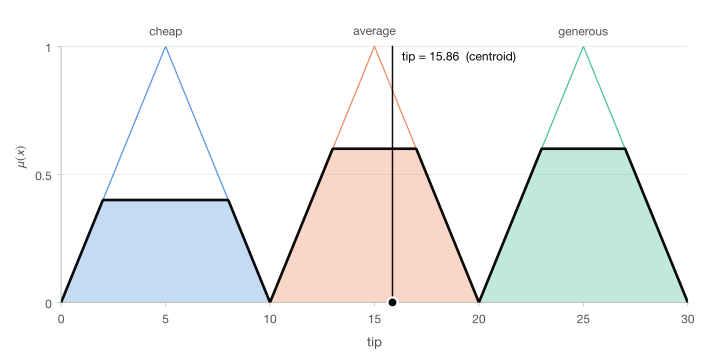
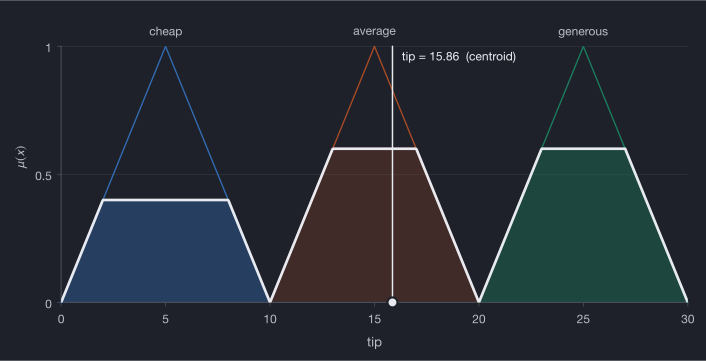
plot.mamdani_output.A first system
Variables are LinguisticVariables from
Sets and scales; rules are plain strings. evaluate takes every
input by name (inside its universe) and returns a dict with one value per output.
from bulanik.inference import MamdaniFIS
from bulanik.sets import LinguisticVariable, triangular

service = LinguisticVariable("service", (0, 10), {
    "poor": triangular(0, 0, 5), "average": triangular(0, 5, 10), "good": triangular(5, 10, 10)})
food = LinguisticVariable("food", (0, 10), {
    "rancid": triangular(0, 0, 5), "delicious": triangular(5, 10, 10)})
tip = LinguisticVariable("tip", (0, 30), {
    "cheap": triangular(0, 5, 10), "average": triangular(10, 15, 20),
    "generous": triangular(20, 25, 30)})

fis = MamdaniFIS([service, food], [tip], [
    "IF service IS poor OR food IS rancid THEN tip IS cheap",
    "IF service IS average THEN tip IS average",
    "IF service IS good OR food IS delicious THEN tip IS generous",
])
print(fis.evaluate({"service": 3, "food": 8}))
print(fis.evaluate({"service": 9, "food": 9}))
{'tip': 15.86209115877786}
{'tip': 22.272709090909093}
Rules
The full grammar, with the reserved words and the error messages, is in the
bulanik.inference.rules module description. In short:
IF <antecedent> THEN <var> IS <term> [AND <var> IS <term> ...] [WITH <weight>]
- Keywords (
IF THEN IS NOT AND OR WITH) are case-insensitive and ASCII only, and cannot be used as variable or term names. - Names are a letter or underscore followed by letters, digits or underscores, with no
spaces:
very_highandx2are fine. Letters outside ASCII are allowed, so Turkish names such ashizmet/yemek/bahşişwork. - An atom is
var IS termorvar IS NOT term(degree \(1 - \mu\)).NOTappears only afterIS, never in a consequent. ANDbinds tighter thanOR; parentheses group.WITH wmultiplies the strength by \(w \in [0, 1]\) (default 1).- A rule may name several outputs (
THEN a IS x AND b IS y) or leave an output out.
You can also build rules from objects: Term, And, Or and Rule, with the Python
operators &, | and ~ on terms. str(rule) prints canonical text that
parse_rule reads back.
from bulanik.inference import MamdaniFIS, Rule, Term, parse_rule
from bulanik.sets import LinguisticVariable, triangular

hizmet = LinguisticVariable("hizmet", (0, 10), {"kötü": triangular(0, 0, 5), "iyi": triangular(5, 10, 10)})
yemek = LinguisticVariable("yemek", (0, 10), {"bayat": triangular(0, 0, 5), "lezzetli": triangular(5, 10, 10)})
bahsis = LinguisticVariable("bahşiş", (0, 20), {"az": triangular(0, 0, 10), "çok": triangular(10, 20, 20)})

built = Rule(Term("hizmet", "iyi") | ~Term("yemek", "bayat"), {"bahşiş": "çok"}, 0.8)
print(built)
print(parse_rule(str(built)) == built)
fis = MamdaniFIS([hizmet, yemek], [bahsis], [built, "IF hizmet IS kötü THEN bahşiş IS az"])
print(fis.evaluate({"hizmet": 8, "yemek": 2}))
IF hizmet IS iyi OR yemek IS NOT bayat THEN bahşiş IS çok WITH 0.8
True
{'bahşiş': 16.07885238720981}
Operators and defuzzifiers
Every option is a string, checked at construction, and the defaults are those of the first row of each list.
| Option | Choices | Meaning |
|---|---|---|
and_method |
"min", "prod" |
t-norm for AND: \(\min(a, b)\) or \(ab\) |
or_method |
"max", "probor" |
t-conorm for OR: \(\max(a, b)\) or \(a + b - ab\) |
implication |
"min", "prod" |
clip \(\min(\alpha, \mu)\) or scale \(\alpha\mu\) the consequent |
aggregation |
"max", "sum", "probor" |
combine implied sets: \(\max\), \(a + b\) (not clipped to 1, as in MATLAB), or \(a + b - ab\) |
defuzzification |
"centroid", "bisector", "mom", "som", "lom" |
see below |
resolution |
integer \(\ge 2\), default 1001 | samples per output universe |
With each output universe sampled at the evenly spaced points \(x_i\) (endpoints included), the aggregated set is
where \(B_k\) is the consequent term of rule \(k\). The crisp output is a function of the
samples \((x_i, \mu_i)\) (see
defuzzify_samples):
| Method | Result |
|---|---|
centroid |
\(\sum_i x_i \mu_i \big/ \sum_i \mu_i\) |
bisector |
the first \(x_i\) where the running sum of \(\mu\) reaches half of the total |
mom, som, lom |
the mean, smallest and largest \(x_i\) among the samples whose \(\mu_i\) is within \(10^{-12}\) of the maximum |
The centroid is the usual choice because it moves smoothly with the inputs;
mom/som/lom jump when the maximum moves from one plateau to another. You can call
defuzzify_samples directly on any samples.
from bulanik.inference import MamdaniFIS, defuzzify_samples
from bulanik.sets import LinguisticVariable, triangular

service = LinguisticVariable("service", (0, 10), {
    "poor": triangular(0, 0, 5), "good": triangular(5, 10, 10)})
tip = LinguisticVariable("tip", (0, 20), {
    "low": triangular(0, 0, 10), "high": triangular(10, 20, 20)})
rules = ["IF service IS poor THEN tip IS low", "IF service IS good THEN tip IS high"]

for method in ("centroid", "bisector", "mom", "som", "lom"):
    fis = MamdaniFIS([service], [tip], rules, defuzzification=method)
    print(f"{method:9s}", round(fis.evaluate({"service": 7.5})["tip"], 3))
print("prod / sum:", round(MamdaniFIS([service], [tip], rules, implication="prod",
                                      aggregation="sum").evaluate({"service": 7.5})["tip"], 3))
print(defuzzify_samples([0, 1, 2, 3], [0, 1, 1, 0], "centroid"))   # a trapezoid's centre
centroid  16.116
bisector  16.26
mom       17.5
som       15.0
lom       20.0
prod / sum: 16.673
1.5
Seeing the control surface
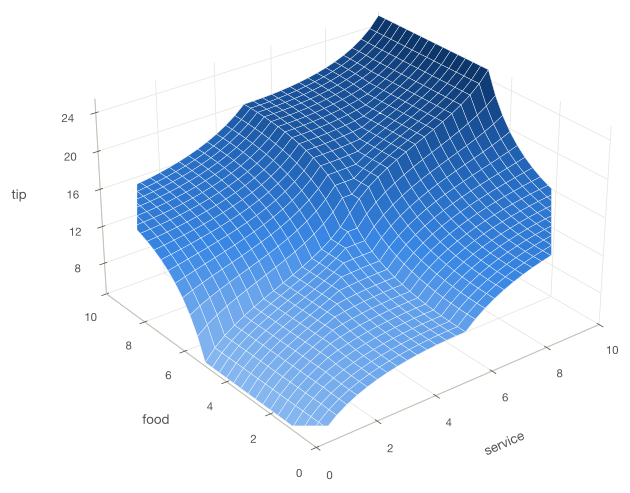
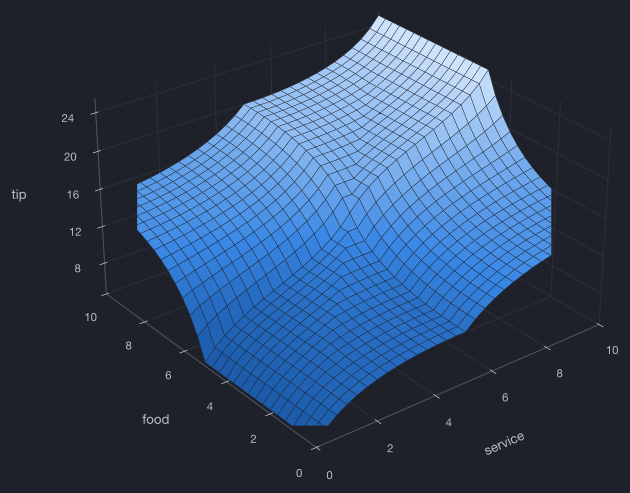
plot.surface draws the whole input-output map of a system with
one or two inputs (a curve or a coloured surface); it works for every system in this
library. For the tipper it shows the flat corners where one rule dominates and the
ridges where the rules blend.
Explaining a result
explain evaluates and returns an Explanation:
the membership degrees of every input in every term, one
RuleActivation per rule (the rule text and
its strength, weight included) and the crisp outputs that evaluate returns.
from bulanik.inference import MamdaniFIS
from bulanik.sets import LinguisticVariable, triangular

service = LinguisticVariable("service", (0, 10), {
    "poor": triangular(0, 0, 5), "good": triangular(5, 10, 10)})
food = LinguisticVariable("food", (0, 10), {
    "rancid": triangular(0, 0, 5), "delicious": triangular(5, 10, 10)})
tip = LinguisticVariable("tip", (0, 20), {
    "low": triangular(0, 0, 10), "high": triangular(10, 20, 20)})
fis = MamdaniFIS([service, food], [tip], [
    "IF service IS poor AND food IS rancid THEN tip IS low",
    "IF service IS good OR food IS delicious THEN tip IS high WITH 0.9",
])
info = fis.explain({"service": 3, "food": 8})
print(info.degrees)
for activation in info.activations:
    print(f"{activation.strength:.2f}  {activation.rule}")
print(info.outputs)
{'service': {'poor': 0.4, 'good': 0.0}, 'food': {'rancid': 0.0, 'delicious': 0.6}}
0.00  IF service IS poor AND food IS rancid THEN tip IS low
0.54  IF service IS good OR food IS delicious THEN tip IS high WITH 0.9
{'tip': 16.188791609667124}
When no rule fires
If every rule's strength is 0 for an output, the aggregate is empty and there is nothing
to defuzzify. By default a
NoRuleFiredError (a ValueError) is
raised. It carries output (the variable name) and explanation, the same
Explanation that explain would have returned, with every strength 0, so you can see
which input fell through the gaps in your rule base. To return a fixed value instead,
pass default={"tip": 10}, one in-universe value per output.
from bulanik.inference import MamdaniFIS, NoRuleFiredError
from bulanik.sets import LinguisticVariable, triangular

x = LinguisticVariable("x", (0, 10), {"lo": triangular(0, 0, 3)})
y = LinguisticVariable("y", (0, 10), {"low": triangular(0, 0, 10)})
rules = ["IF x IS lo THEN y IS low"]

try:
    MamdaniFIS([x], [y], rules).evaluate({"x": 8})
except NoRuleFiredError as error:
    print(error)
    print(error.output, error.explanation.degrees, error.explanation.activations[0].strength)
print(MamdaniFIS([x], [y], rules, default={"y": 5}).evaluate({"x": 8}))
no rule fired for output 'y' and no default was given; the error's .explanation holds the input degrees and rule activations
y {'x': {'lo': 0.0}} 0.0
{'y': 5.0}
Pitfalls
Inputs must lie inside their universe, must be given for every input variable and no
others, and must be finite numbers (a bool or a string is a TypeError). Inputs are
never clamped; a sensor value just past the end of the universe is an error, not a
silent 10.
Rule text is checked at construction. An unknown variable or term, a keyword used as
a name, NOT in a consequent, a weight outside \([0, 1]\), or an output named twice in one
consequent raises ValueError, usually naming the offset in the rule text.
resolution trades accuracy for time. The output is exact only up to the sampling
grid. For the two-rule example above (service 7.5) the centroid is 16.67 at resolution
11, 16.16 at 101, 16.116 at 1001 and 16.112 at 10001; the default 1001 is accurate to
about three decimals for ordinary shapes. bisector, mom, som and lom return grid
points, so they move in steps of one grid cell.
aggregation="sum" can exceed 1, which is intended (it is MATLAB's sum); centroid
and bisector then weight overlapping rules more heavily than max does.
A consequent term must be visible on the grid. A term that is 0 at every sample
(entirely outside the output universe, or narrower than one grid cell) is rejected at
construction, with a message that suggests moving it or raising resolution. If a rule
seems ignored, explain shows whether it fired and the figure shows what it contributed.
from bulanik.inference import MamdaniFIS
from bulanik.sets import LinguisticVariable, triangular

x = LinguisticVariable("x", (0, 10), {"lo": triangular(0, 0, 5), "hi": triangular(5, 10, 10)})
y = LinguisticVariable("y", (0, 10), {"low": triangular(0, 0, 5), "high": triangular(5, 10, 10)})
rules = ["IF x IS lo THEN y IS low", "IF x IS hi THEN y IS high"]

def show(make):
    try:
        print(make())
    except Exception as error:
        print(f"{type(error).__name__}: {error}")

fis = MamdaniFIS([x], [y], rules)
show(lambda: fis.evaluate({"x": 11}))
show(lambda: fis.evaluate({}))
show(lambda: fis.evaluate({"x": True}))
show(lambda: MamdaniFIS([x], [y], ["IF x IS medium THEN y IS low"]))
show(lambda: MamdaniFIS([x], [y], ["IF x IS lo THEN y IS NOT low"]))
show(lambda: MamdaniFIS([x], [y], ["IF x IS lo THEN y IS low WITH 1.5"]))
show(lambda: MamdaniFIS([x], [y], rules, defuzzification="median"))
show(lambda: MamdaniFIS([x], [y], rules, resolution=1))
show(lambda: MamdaniFIS([x], [y], rules, default={"y": 50}))
gone = LinguisticVariable("z", (0, 10), {"gone": triangular(20, 25, 30)})
show(lambda: MamdaniFIS([x], [gone], ["IF x IS lo THEN z IS gone"]))
ValueError: 'x' input 11 is outside its universe [0, 10]
ValueError: missing input 'x'; inputs: 'x' on [0, 10]
TypeError: input of 'x' must be a number, got bool True
ValueError: unknown term 'medium' of 'x' in rule 'IF x IS medium THEN y IS low'; valid: lo, hi
ValueError: NOT is not allowed in a consequent (offset 21) in rule 'IF x IS lo THEN y IS NOT low'
ValueError: rule weight 1.5 must be in [0, 1]
ValueError: unknown defuzzification method 'median' for MamdaniFIS; valid: centroid, bisector, mom, som, lom
ValueError: resolution must be an integer >= 2, got 1
ValueError: default of 'y' is 50, outside its universe [0, 10]
ValueError: MamdaniFIS: output 'z' term 'gone' (a rule consequent) has membership 0 at all 1001 samples of [0, 10] (resolution=1001); it lies outside the universe or between samples, so a rule firing on it would be lost. Move the term inside the universe or raise resolution
See also
- Sugeno and Tsukamoto for crisp consequents, and Interval type-2 for uncertain membership functions.
- Sets and scales for the membership functions and variables.
- API:
bulanik.inference,bulanik.plot. - Example: 10 Mamdani tipper.
- Mamdani and Assilian (1975), "An experiment in linguistic synthesis with a fuzzy logic controller", International Journal of Man-Machine Studies.