Interval type-2 trapezoids: IT2TrFN
A trapezoid says "roughly between 4 and 6, never below 2 or above 9". An interval type-2 trapezoidal number admits that even this description is vague: instead of one trapezoid it carries two, an upper and a lower membership function, and the region between them is the footprint of uncertainty. Use it when you want a linguistic term ("high") to be uncertain about its own shape, as in the interval type-2 TOPSIS and AHP literature.
This page is about the number IT2TrFN, which you can
add, multiply, score and aggregate. For interval type-2 sets and inference systems
(Mamdani and Sugeno rule bases, type reduction) see
Interval type-2 inference.
The number
Each trapezoid is \((a_1, a_2, a_3, a_4; h_1, h_2)\): the membership rises from 0 at
\(a_1\) to \(h_1\) at \(a_2\), goes linearly to \(h_2\) at \(a_3\) and falls to 0 at \(a_4\)
(Chen and Lee 2010). You build IT2TrFN(upper, lower) from two six-tuples
\((a_1, a_2, a_3, a_4, h_1, h_2)\).
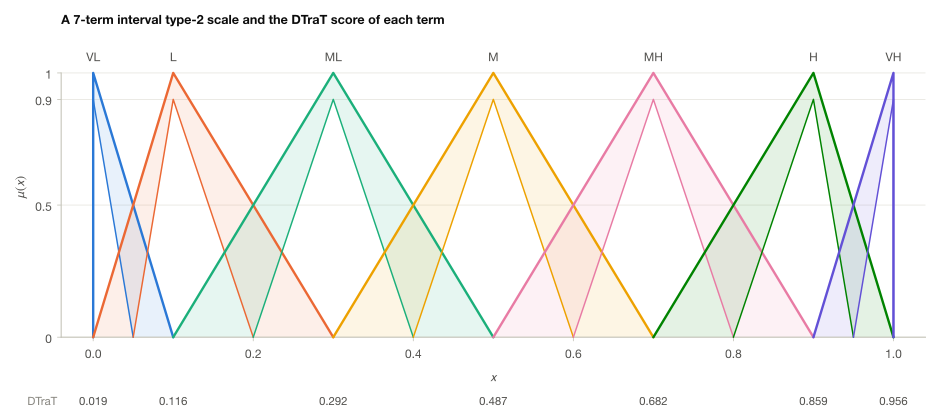
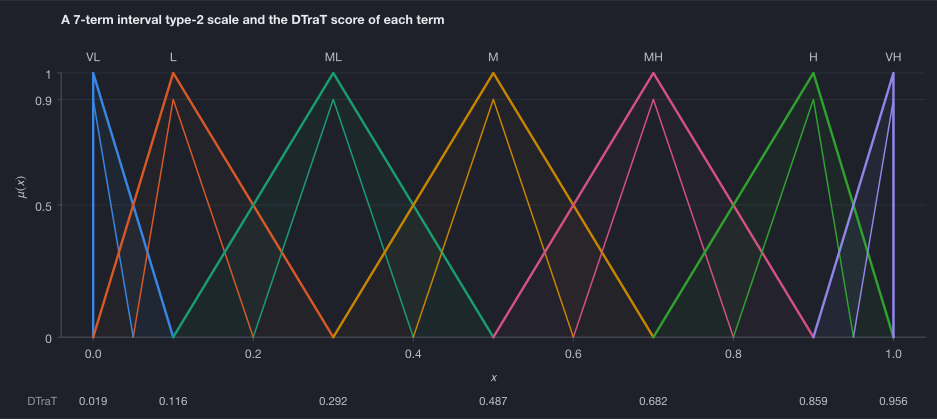
plot.it2_number: upper trapezoid (bold), lower trapezoid
(thin), footprint of uncertainty between them. The numbers under the axis are the DTraT
scores. The scale is illustrative, in the style of the interval type-2 TOPSIS
literature; the values are not a transcription of any published table.from bulanik import IT2TrFN, TFN, TrFN
low = IT2TrFN((0, 0.1, 0.1, 0.3, 1, 1), (0.05, 0.1, 0.1, 0.2, 0.9, 0.9))
print(low.upper)
print(low.lower)
print(IT2TrFN.from_trfn(TrFN(1, 2, 3, 5))) # a type-1 number: upper = lower, zero-width footprint
print(IT2TrFN.from_trfn(TFN(1, 2, 3)).upper)
(0.0, 0.1, 0.1, 0.3, 1.0, 1.0)
(0.05, 0.1, 0.1, 0.2, 0.9, 0.9)
IT2TrFN(upper=(1.0, 2.0, 3.0, 5.0, 1.0, 1.0), lower=(1.0, 2.0, 3.0, 5.0, 1.0, 1.0))
(1.0, 2.0, 2.0, 3.0, 1.0, 1.0)
Nesting
The lower trapezoid must be nested in the upper one (up to \(10^{-12}\)):
and the upper trapezoid needs \(\max(h_1, h_2) > 0\). The violated inequality is named in
the ValueError. Nesting guarantees that the lower membership never exceeds the upper
one, and it is preserved by the sum, difference, non-negative product, scalar and power,
so arithmetic never leaves the class. It is the usual assumption of the interval type-2
MCDM literature. General containment is slightly weaker, but the sum of two merely
contained numbers can leave the footprint constraint, so it is not enough for a closed
arithmetic.
Arithmetic
Following Chen and Lee (2010a) every operation applies the type-1 rule to the upper and
to the lower trapezoid, and the heights combine with min:
- sum: points add; difference: \((a_1 - b_4, a_2 - b_3, a_3 - b_2, a_4 - b_1)\);
- product: componentwise, for non-negative points;
- scalar \(k\): points times \(k\), heights unchanged (for \(k < 0\) the points reverse and \(h_1, h_2\) swap);
- power \(k\): points to the power \(k\), heights unchanged (for \(k < 0\) the points reverse and the heights swap). The product and power give the geometric mean \((\prod \tilde a_i)^{1/n}\) of Kahraman et al. (2014).
There is a single operator family, "algebraic".
from bulanik import IT2TrFN
from bulanik.aggregate import wa, wg

low = IT2TrFN((0, 0.1, 0.1, 0.3, 1, 1), (0.05, 0.1, 0.1, 0.2, 0.9, 0.9))
high = IT2TrFN((0.5, 0.7, 0.7, 0.9, 1, 1), (0.55, 0.7, 0.7, 0.85, 0.9, 0.9))

def r(t):
    return tuple(round(v, 4) for v in t)

print("low + high   ", r((low + high).upper), r((low + high).lower))
print("high - low   ", r((high - low).upper))
print("low * high   ", r((low * high).upper))
print("2 * low      ", r((2 * low).upper))
print("low ** 2     ", r((low ** 2).upper))
print("wa           ", r(wa([low, high]).upper))
print("wg           ", r(wg([low, high]).upper))
low + high    (0.5, 0.8, 0.8, 1.2, 1.0, 1.0) (0.6, 0.8, 0.8, 1.05, 0.9, 0.9)
high - low    (0.2, 0.6, 0.6, 0.9, 1.0, 1.0)
low * high    (0.0, 0.07, 0.07, 0.27, 1.0, 1.0)
2 * low       (0.0, 0.2, 0.2, 0.6, 1.0, 1.0)
low ** 2      (0.0, 0.01, 0.01, 0.09, 1.0, 1.0)
wa            (0.25, 0.4, 0.4, 0.6, 1.0, 1.0)
wg            (0.0, 0.2646, 0.2646, 0.5196, 1.0, 1.0)
Scores and distance
The default score is "dtrat". All three are defuzzifications of the whole number:
| Score | Formula |
|---|---|
"dtrat" (default) |
\(\tfrac12 \sum_{X \in \{U, L\}} \Big[\dfrac{(a^X_4 - a^X_1) + (h^X_1 a^X_2 - a^X_1) + (h^X_2 a^X_3 - a^X_1)}{4} + a^X_1\Big]\) (the DTraT of Kahraman et al. 2014; for a type-1 trapezoid with heights 1 it is the mean of the four points) |
"centroid" |
the mean of the x-centroids of the upper and the lower polygon \((a_1, 0), (a_2, h_1), (a_3, h_2), (a_4, 0)\) by the shoelace formula (the mean of the points if the area is zero). This is bulanik's own choice, not the Karnik-Mendel centroid of the type-2 set |
"chen_lee" |
\(\sum_{X \in \{U, L\}} \Big[\sum_{p=1}^{3} M_p(X) - \tfrac14 \sum_{q=1}^{4} S_q(X) + h_1(X) + h_2(X)\Big]\) with \(M_p = (a_p + a_{p+1})/2\), \(S_q\) (\(q \le 3\)) the population standard deviation of \(\{a_q, a_{q+1}\}\) and \(S_4\) that of \(\{a_1, \dots, a_4\}\) (the ranking value of Chen and Lee 2010a) |
There is no accuracy function. The only distance is "vertex",
\(\sqrt{\tfrac18 \sum (\Delta a)^2}\) over the 8 points of the two trapezoids; heights are
ignored. "chen_lee" is a ranking value, not a value on the scale of the points: it adds
heights, so compare it only with other "chen_lee" values.
from bulanik import IT2TrFN

low = IT2TrFN((0, 0.1, 0.1, 0.3, 1, 1), (0.05, 0.1, 0.1, 0.2, 0.9, 0.9))
high = IT2TrFN((0.5, 0.7, 0.7, 0.9, 1, 1), (0.55, 0.7, 0.7, 0.85, 0.9, 0.9))
for name in IT2TrFN.SCORES:
    print(f"{name:9}", round(low.score(name), 5), round(high.score(name), 5))
print(round(low.distance(high), 4))
print(IT2TrFN.SCORES, IT2TrFN.ACCURACIES, IT2TrFN.DISTANCES)
dtrat     0.11625 0.6825
centroid  0.125 0.7
chen_lee  4.37789 7.85063
0.5834
('dtrat', 'centroid', 'chen_lee') () ('vertex',)
In a decision
A LinguisticScale of IT2TrFN terms turns words
into interval type-2 numbers, DecisionMatrix and
rank_fuzzy aggregate the experts and rank with the
"dtrat" score, and ahp_fuzzy_numbers
turns a matrix of interval type-2 judgements into weights (Kahraman et al. 2014).
from bulanik import IT2TrFN
from bulanik.mcdm import DecisionMatrix, rank_fuzzy
from bulanik.scales import LinguisticScale

scale = LinguisticScale("demo", {
    "L": IT2TrFN((0, 0.1, 0.1, 0.3, 1, 1), (0.05, 0.1, 0.1, 0.2, 0.9, 0.9)),
    "H": IT2TrFN((0.5, 0.7, 0.7, 0.9, 1, 1), (0.55, 0.7, 0.7, 0.85, 0.9, 0.9)),
})
dm = DecisionMatrix.from_terms(
    scale, ["A", "B"], ["price", "quality"],
    [[["L", "H"], ["H", "L"]],            # expert 1: rows are alternatives A, B
     [["H", "H"], ["H", "L"]]],           # expert 2
)
r = rank_fuzzy(dm, [0.5, 0.5], ["benefit", "cost"], method="codas")
print(r.ranking, r.operators["score"])
('B', 'A') dtrat
Pitfalls
Nesting is a hard rule. A lower height above \(\min(h^U_1, h^U_2)\), or a lower point
outside the upper trapezoid, raises ValueError naming the inequality. A lower
trapezoid drawn "a bit wider" is an error, not a warning.
Six values per trapezoid. The order is \((a_1, a_2, a_3, a_4, h_1, h_2)\), points first, heights last. Points must be ordered and finite, heights in \([0, 1]\) (out by at most \(10^{-12}\) they are projected).
Products need non-negative points. mul raises for a trapezoid with a negative
point; the geometric mean wg likewise.
No accuracy, one distance. accuracy() raises ValueError, because the class has
no accuracy function.
It is not a type-1 number. IT2TrFN + TFN raises TypeError; convert with
IT2TrFN.from_trfn first.
from bulanik import IT2TrFN, TFN

def show(make):
    try:
        print(make())
    except Exception as error:
        print(f"{type(error).__name__}: {error}")

low = IT2TrFN((0, 0.1, 0.1, 0.3, 1, 1), (0.05, 0.1, 0.1, 0.2, 0.9, 0.9))
show(lambda: IT2TrFN((0, 1, 2, 3, 0.5, 0.5), (0.5, 1, 2, 2.5, 0.9, 0.9)))   # lower height above upper
show(lambda: IT2TrFN((0, 1, 2, 3, 1, 1), (-0.5, 1, 2, 2.5, 0.9, 0.9)))      # lower pokes out
show(lambda: IT2TrFN((0, 1, 2, 3, 1), (0, 1, 2, 3, 1, 1)))                  # five values
show(lambda: IT2TrFN((0, 2, 1, 3, 1, 1), (0, 2, 1, 3, 1, 1)))               # unordered points
show(lambda: IT2TrFN((0, 1, 2, 3, 0, 0), (0, 1, 2, 3, 0, 0)))               # no membership at all
show(lambda: low.accuracy())
show(lambda: low.score("median"))
show(lambda: low * IT2TrFN((-1, 0, 0, 1, 1, 1), (-1, 0, 0, 1, 1, 1)))
show(lambda: low + TFN(1, 2, 3))
ValueError: IT2TrFN needs nested reference points: h1L <= min(h1U, h2U), got 0.9 > 0.5
ValueError: IT2TrFN needs nested reference points: a1U <= a1L, got 0 > -0.5
ValueError: upper needs 6 values (a1, a2, a3, a4, h1, h2), got 5
ValueError: IT2TrFN needs a1 <= a2 <= a3 <= a4 in the upper trapezoid, got (0.0, 2.0, 1.0, 3.0)
ValueError: the upper trapezoid needs max(h1, h2) > 0
ValueError: IT2TrFN has no accuracy function
ValueError: unknown score 'median' for IT2TrFN; valid: dtrat, centroid, chen_lee
ValueError: mul needs all points >= 0, got lowest points 0 and -1
TypeError: unsupported operand type(s) for +: 'IT2TrFN' and 'TFN'
See also
- Interval type-2 inference for interval type-2 sets and fuzzy systems.
- Interval-valued numbers for the orthopair and neutrosophic
interval kinds, Triangular numbers for the type-1
TrFN. - Aggregation, Sets and scales, More ranking methods and More weighting methods.
- API:
IT2TrFN,plot.it2_number. - Example: 14 interval type-2 versus type-1 under noise.
- Chen and Lee (2010a), Expert Systems with Applications 37(1), 824-833, doi:10.1016/j.eswa.2009.06.094 (arithmetic and ranking value); Chen and Lee (2010b), Expert Systems with Applications 37(4), 2790-2798, doi:10.1016/j.eswa.2009.09.012 (interval type-2 TOPSIS); Kahraman, Oztaysi, Ucal Sari and Turanoglu (2014), Knowledge-Based Systems 59, 48-57, doi:10.1016/j.knosys.2014.02.001 (DTraT, interval type-2 AHP).