Interval-valued numbers: IVQROFN and IVNeutrosophicFN
An expert is rarely sure of a degree itself. "My support is somewhere between 0.4 and 0.5, and my opposition between 0.3 and 0.4." An interval-valued number keeps that second layer of doubt: every degree of an orthopair or three-part number becomes an interval. bulanik has two families:
| Class | Parts | Constraint |
|---|---|---|
IVQROFN |
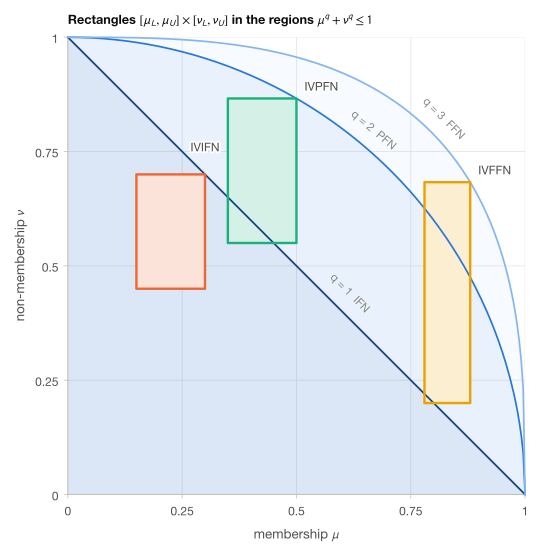
membership \([\mu_L, \mu_U]\), non-membership \([\nu_L, \nu_U]\), rung \(q\) | \(\mu_U^q + \nu_U^q \le 1\) |
IVIFN |
the same with \(q = 1\) (Atanassov and Gargov 1989) | \(\mu_U + \nu_U \le 1\) |
IVPFN |
the same with \(q = 2\) (Peng and Yang 2016) | \(\mu_U^2 + \nu_U^2 \le 1\) |
IVFFN |
the same with \(q = 3\) (Jeevaraj 2021) | \(\mu_U^3 + \nu_U^3 \le 1\) |
IVNeutrosophicFN |
truth \([t_L, t_U]\), indeterminacy \([i_L, i_U]\), falsity \([f_L, f_U]\) (Wang et al. 2005) | none, each bound in \([0, 1]\) |
Every bound lies in \([0, 1]\), each lower bound is at most its upper bound, and for the
orthopair family only the upper pair carries the rung constraint. If the upper
corner is admissible, the whole rectangle is, because the lower pair is componentwise
smaller. IVIFN, IVPFN and IVFFN are IVQROFN with the rung fixed, so everything
below holds for all four. They are still separate classes: the same data in an alias and
in IVQROFN does not compare equal and does not mix in arithmetic. You build IVIFN(mu_l, mu_u, nu_l, nu_u) and
IVQROFN(mu_l, mu_u, nu_l, nu_u, q).
plot.iv_orthopair.from bulanik import IFN, IVFFN, IVIFN, IVPFN, IVQROFN
x = IVIFN(0.4, 0.5, 0.3, 0.4)
print(x, x.q)
print(tuple(round(h, 4) for h in x.hesitancy)) # (pi_L, pi_U): the interval of hesitancy
print(x.complement()) # membership and non-membership swapped
print(IVIFN.from_qrofn(IFN(0.6, 0.3))) # a point is a degenerate interval
print(IVPFN(0.6, 0.8, 0.5, 0.6)) # the rung q = 2 admits this pair
print(IVQROFN(0.6, 0.8, 0.3, 0.5, 3) == IVFFN(0.6, 0.8, 0.3, 0.5)) # False: same data, different class
IVIFN(mu_l=0.4, mu_u=0.5, nu_l=0.3, nu_u=0.4) 1
(0.1, 0.3)
IVIFN(mu_l=0.3, mu_u=0.4, nu_l=0.4, nu_u=0.5)
IVIFN(mu_l=0.6, mu_u=0.6, nu_l=0.3, nu_u=0.3)
IVPFN(mu_l=0.6, mu_u=0.8, nu_l=0.5, nu_u=0.6)
False
Operations: the point law at both ends
Every operation applies the point law of QROFN to the lower
pair \((a_L, b_L) = (\mu_L^q, \nu_L^q)\) and to the upper pair
\((a_U, b_U) = (\mu_U^q, \nu_U^q)\) separately, then takes the \(q\)-th root of each
result part. The two operator families, ops="algebraic" (the default, and what
+ * ** use) and ops="einstein", are the ones in the table of
Orthopair numbers.
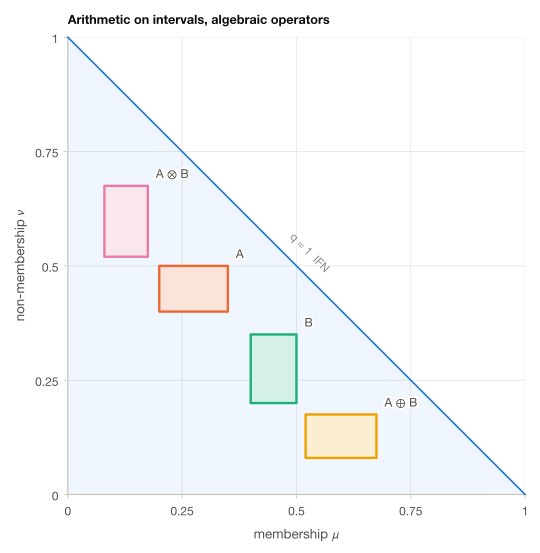
For \(q = 1\) and the algebraic operators this is Xu's (2007) arithmetic, for example
Each point law is monotone in every argument, so the lower bounds stay below the upper
ones and no operation can invert an interval. The upper pair carries the constraint and
is checked and projected exactly as QROFN does.
from bulanik import IVIFN, IVPFN

a, b = IVIFN(0.4, 0.5, 0.3, 0.4), IVIFN(0.5, 0.6, 0.2, 0.3)

def box(n):
    return f"mu [{n.mu_l:.4f}, {n.mu_u:.4f}]  nu [{n.nu_l:.4f}, {n.nu_u:.4f}]"

print("a + b             ", box(a + b))
print("a.add(b, einstein)", box(a.add(b, ops="einstein")))
print("a * b             ", box(a * b))
print("a.scale(2)        ", box(a.scale(2)))
print("a ** 2            ", box(a ** 2))
print("IVPFN ** 2        ", box(IVPFN(0.6, 0.8, 0.5, 0.6) ** 2))
print(IVIFN.OPS)
a + b              mu [0.7000, 0.8000]  nu [0.0600, 0.1200]
a.add(b, einstein) mu [0.7500, 0.8462]  nu [0.0385, 0.0845]
a * b              mu [0.2000, 0.3000]  nu [0.4400, 0.5800]
a.scale(2)         mu [0.6400, 0.7500]  nu [0.0900, 0.1600]
a ** 2             mu [0.1600, 0.2500]  nu [0.5100, 0.6400]
IVPFN ** 2         mu [0.3600, 0.6400]  nu [0.6614, 0.7684]
('algebraic', 'einstein')
IVQROFN.add
and IVQROFN.mul.Scores, accuracy and distance
With \(a = \mu^q\), \(b = \nu^q\) and \(\pi_L = 1 - a_U - b_U\), \(\pi_U = 1 - a_L - b_L\)
(powers, no root; the hesitancy property is the \(q\)-th root of these, \(\pi^{1/q}\)):
| Quantity | Names (default first) | Formula |
|---|---|---|
| score | "difference" |
\(S = \tfrac12(\mu_L^q + \mu_U^q - \nu_L^q - \nu_U^q)\) |
"normalized" |
\((1 + S)/2\), a score in \([0, 1]\) | |
"defuzzified" |
\(q = 1\) only, the defuzzified value of the interval-valued intuitionistic number (see score) |
|
| accuracy | "sum" |
\(H = \tfrac12(\mu_L^q + \mu_U^q + \nu_L^q + \nu_U^q)\) |
| distance | "hamming" |
\(\tfrac14 \sum \lvert\Delta\rvert\) over \((a_L, a_U, b_L, b_U, \pi_L, \pi_U)\) |
"euclidean" |
\(\sqrt{\tfrac14 \sum \Delta^2}\) over the same six |
The score is Xu's (2007) for \(q = 1\) and Peng and Yang's (2016) for \(q = 2\). Garg's (2016) accuracy function for \(q = 2\) is not implemented. For degenerate intervals (lower equal to upper) every value equals the one the point number would give.
from bulanik import IVIFN

a, b = IVIFN(0.4, 0.5, 0.3, 0.4), IVIFN(0.5, 0.6, 0.2, 0.3)
print(round(a.score(), 4), round(a.score("normalized"), 4), round(a.accuracy(), 4))
print(round(a.distance(b), 4), round(a.distance(b, "euclidean"), 4))
print(IVIFN.SCORES, IVIFN.ACCURACIES, IVIFN.DISTANCES)
0.1 0.55 0.8
0.1 0.1
('difference', 'normalized', 'defuzzified') ('sum',) ('hamming', 'euclidean')
The default score is signed (it lies in \([-1, 1]\)). A ratio method such as MARCOS
needs positive values, so rank orthopair data with score="normalized"; see
More ranking methods.
Interval neutrosophic numbers
An IVNeutrosophicFN
\(\langle [t_L, t_U], [i_L, i_U], [f_L, f_U] \rangle\) gives an interval of truth,
indeterminacy and falsity. As for the single-valued
NeutrosophicFN there is no joint constraint.
Its only operator family is "algebraic", the arithmetic of Zhang, Wang and Chen
(2014): the law of NeutrosophicFN on the lower triple and on the upper triple
separately.
| Operation | \(T\) | \(I\) | \(F\) |
|---|---|---|---|
add |
\([t^L_1 + t^L_2 - t^L_1 t^L_2,\ t^U_1 + t^U_2 - t^U_1 t^U_2]\) | \([i^L_1 i^L_2,\ i^U_1 i^U_2]\) | \([f^L_1 f^L_2,\ f^U_1 f^U_2]\) |
mul |
\([t^L_1 t^L_2,\ t^U_1 t^U_2]\) | \([i^L_1 + i^L_2 - i^L_1 i^L_2,\ \dots]\) | \([f^L_1 + f^L_2 - f^L_1 f^L_2,\ \dots]\) |
scale by \(k\) |
\([1 - (1 - t_L)^k,\ 1 - (1 - t_U)^k]\) | \([i_L^k,\ i_U^k]\) | \([f_L^k,\ f_U^k]\) |
power by \(k\) |
\([t_L^k,\ t_U^k]\) | \([1 - (1 - i_L)^k,\ \dots]\) | \([1 - (1 - f_L)^k,\ \dots]\) |
The scoring is different from the orthopair family. The only score is "average",
and there is no "normalized":
the NeutrosophicFN score \((2 + t - i - f)/3\) on the interval midpoints. Zhang et al.
(2014, Definition 18) define an interval-valued score
\([t_L + 2 - i_U - f_U,\ t_U + 2 - i_L - f_L]\); its midpoint is \(3S\), so "average"
ranks exactly as that midpoint does. It lies in \([0, 1]\) and is \(0\) only for the
number \(\langle [0,0], [1,1], [1,1] \rangle\). The accuracy is "difference" (default)
\(\tfrac12(t_L + t_U - f_L - f_U)\) or "certainty" \(\tfrac12(t_L + t_U)\). The distances
"hamming" \(\tfrac16 \sum \lvert\Delta\rvert\) and "euclidean"
\(\sqrt{\tfrac16 \sum \Delta^2}\) run over the six bounds.
from bulanik import IVNeutrosophicFN

n = IVNeutrosophicFN(0.6, 0.7, 0.1, 0.2, 0.2, 0.3)
print(round(n.score(), 4), round(n.accuracy(), 4), round(n.accuracy("certainty"), 4))
print(n.complement())
s = n + n
print(tuple(round(v, 4) for v in (s.t_l, s.t_u, s.i_l, s.i_u, s.f_l, s.f_u)))
print(IVNeutrosophicFN.SCORES, IVNeutrosophicFN.ACCURACIES, IVNeutrosophicFN.OPS)
0.75 0.4 0.65
IVNeutrosophicFN(t_l=0.2, t_u=0.3, i_l=0.8, i_u=0.9, f_l=0.6, f_u=0.7)
(0.84, 0.91, 0.01, 0.04, 0.04, 0.09)
('average',) ('difference', 'certainty') ('algebraic',)
A typo in the source
Zhang et al. (2014) print the addition and product with two typos (a \(T\) in place of an \(I\) index). The code follows the general t-norm forms of the same paper.
Averaging opinions
wa and wg accept every kind on this page and apply the point law at both ends, so
an interval-valued rating of several experts aggregates like any other. See
Aggregation.
Rounding and the boundary
A lower bound that exceeds its upper bound by up to \(10^{-12}\) is clamped silently
(lower := upper); a larger inversion raises. The constraint on the upper pair is checked
and projected as for QROFN. The exact rules are in
Conventions.
Pitfalls
Bounds must be ordered. \(\mu_L \le \mu_U\) and \(\nu_L \le \nu_U\) (and the same for
\(t\), \(i\), \(f\)). An inversion beyond \(10^{-12}\) raises ValueError naming the fields.
The rung constraint is on the upper pair. IVIFN(0.4, 0.7, 0.3, 0.5) fails because
\(0.7 + 0.5 > 1\), although its lower pair is fine. Pick the lowest rung that holds the
upper corner.
Rungs do not mix. IVIFN + IVPFN raises TypeError, as does a different q. The
same holds between an alias and IVQROFN: IVQROFN(0.6, 0.8, 0.3, 0.5, 3) + IVFFN(0.6, 0.8, 0.3, 0.5)
raises TypeError and the two compare unequal, although the data is identical. Stay in
one class.
Scale and power need \(k \ge 0\).
Use a positive-valued score for ratio methods. The orthopair default "difference"
is signed, and ahp_fuzzy_numbers or the ratio ranking methods reject non-positive
values. For IVIFN and its relatives pass score="normalized". IVNeutrosophicFN has
no "normalized" score; its single score "average" is already non-negative, and a
non-positive value gets the hint "use a positive-valued score".
from bulanik import IVIFN, IVNeutrosophicFN, IVPFN

def show(make):
    try:
        print(make())
    except Exception as error:
        print(f"{type(error).__name__}: {error}")

show(lambda: IVIFN(0.5, 0.4, 0.1, 0.2))                      # mu_l > mu_u
show(lambda: IVIFN(0.4, 0.7, 0.3, 0.5))                      # upper pair: 0.7 + 0.5 > 1
show(lambda: IVIFN(0.4, 0.5, 0.3, 0.4) + IVPFN(0.4, 0.5, 0.3, 0.4))
show(lambda: IVIFN(0.4, 0.5, 0.3, 0.4).scale(-1))
show(lambda: IVIFN(0.4, 0.5, 0.3, 0.4).score("median"))
show(lambda: IVNeutrosophicFN(0.8, 0.7, 0.1, 0.2, 0.2, 0.3))
show(lambda: IVNeutrosophicFN(0.6, 0.7, 0.1, 0.2, 0.2, 0.3).score("normalized"))
ValueError: need mu_l <= mu_u, got mu_l=0.5, mu_u=0.4
ValueError: need mu_u^1 + nu_u^1 <= 1, got mu_u=0.7, nu_u=0.5 (sum 1.2)
TypeError: unsupported operand type(s) for +: 'IVIFN' and 'IVPFN'
ValueError: scale needs k >= 0, got -1.0
ValueError: unknown score 'median' for IVIFN; valid: difference, normalized, defuzzified
ValueError: need t_l <= t_u, got t_l=0.8, t_u=0.7
ValueError: unknown score 'normalized' for IVNeutrosophicFN; valid: average
See also
- Orthopair numbers and Three-part numbers for the point numbers these generalise.
- Interval type-2 trapezoids for another way to hold uncertainty about a degree, Aggregation, and Choosing a method.
- More ranking methods and More weighting methods for what to do with the scores.
- API:
IVQROFN,IVIFN,IVPFN,IVFFN,IVNeutrosophicFN,plot.iv_orthopair. - Atanassov and Gargov (1989), "Interval valued intuitionistic fuzzy sets", Fuzzy Sets and Systems 31(3), 343-349; Xu (2007), Control and Decision 22(2), 215-219; Peng and Yang (2016), International Journal of Intelligent Systems 31(5), 444-487; Joshi, Singh, Bhatt and Vaisla (2018), Journal of Intelligent & Fuzzy Systems 35(5), 5225-5230; Wang, Smarandache, Zhang and Sunderraman (2005), Interval Neutrosophic Sets and Logic, Hexis; Zhang, Wang and Chen (2014), The Scientific World Journal 2014, article 645953.