Three-part numbers: spherical, picture, neutrosophic
When two degrees are not enough, bulanik offers three types with three parts in \([0, 1]\). Each adds a way to say "neither yes nor no":
| Class | Parts | Constraint | Reads as |
|---|---|---|---|
SphericalFN |
\((\mu, \nu, \pi)\) | \(\mu^2 + \nu^2 + \pi^2 \le 1\) | membership, non-membership, hesitancy |
PictureFN |
\((\mu, \eta, \nu)\) | \(\mu + \eta + \nu \le 1\) | positive, neutral, negative; the rest is refusal |
NeutrosophicFN |
\((t, i, f)\) | none | truth, indeterminacy, falsity, each independent |
Use a picture number for a vote with four outcomes (yes, abstain, no, refuse to
vote), a spherical number when hesitancy is a separate quantity, and a
neutrosophic number when the three judgements are made independently and may
sum to more than 1. All three have one operator family, "algebraic";
scale(k) and power(k) need \(k \ge 0\); the distances are "hamming" (default)
and "euclidean".
Distances. Take the differences \(d_i\) of the two numbers' simplex parts; then Hamming is \(\sum_i \lvert d_i \rvert / D\) and Euclidean is \(\sqrt{\sum_i d_i^2 / D}\):
| Class | Simplex parts | \(D\) |
|---|---|---|
SphericalFN |
\(\mu^2,\; \nu^2,\; \pi^2\) and the refusal \(1 - \mu^2 - \nu^2 - \pi^2\) | 2 |
PictureFN |
\(\mu,\; \eta,\; \nu\) and the refusal \(1 - \mu - \eta - \nu\) | 2 |
NeutrosophicFN |
\(t,\; i,\; f\) | 3 |
Spherical numbers
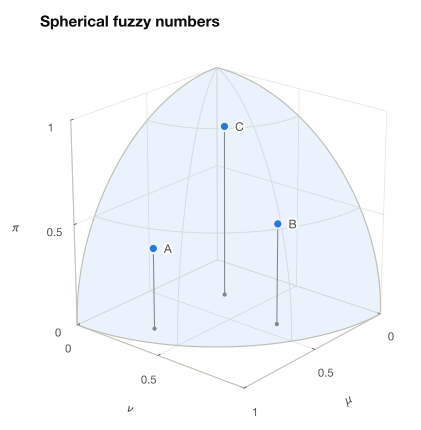
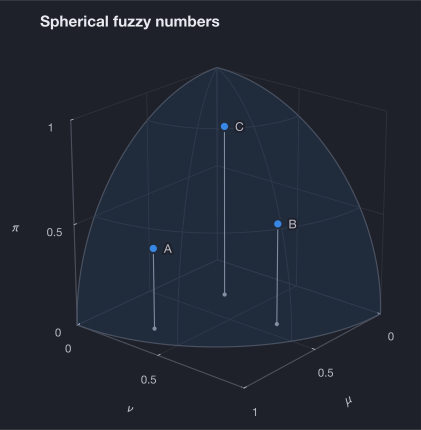
The operations are those of Kutlu Gundogdu and Kahraman (2019), evaluated on the squares \((a, b, c) = (\mu^2, \nu^2, \pi^2)\) and the exact refusal \(r = 1 - a - b - c\); a square root takes each result back:
| Operation | \(\mu^2\) | \(\nu^2\) | \(\pi^2\) |
|---|---|---|---|
add |
\(1 - (1 - a_1)(1 - a_2)\) | \(b_1 b_2\) | \((1 - a_1)(1 - a_2) - (b_1 + r_1)(b_2 + r_2)\) |
mul |
\(a_1 a_2\) | \(1 - (1 - b_1)(1 - b_2)\) | \((1 - b_1)(1 - b_2) - (a_1 + r_1)(a_2 + r_2)\) |
scale by \(k\) |
\(1 - (1 - a)^k\) | \(b^k\) | \((1 - a)^k - (1 - a - c)^k\) |
power by \(k\) |
\(a^k\) | \(1 - (1 - b)^k\) | \((1 - b)^k - (1 - b - c)^k\) |
Scores: "pi_adjusted" (default) \((\mu - \pi)^2 - (\nu - \pi)^2\) and
"normalized" \((1 + s)/2\). Accuracy "sum": \(\mu^2 + \nu^2 + \pi^2\).
from bulanik import SphericalFN

a, b = SphericalFN(0.5, 0.4, 0.3), SphericalFN(0.4, 0.3, 0.2)
print(a, a.parts)
print([round(p, 4) for p in (a + b).parts])
print([round(p, 4) for p in (a * b).parts])
print([round(p, 4) for p in a.scale(2).parts])
print(round(a.score(), 4), round(a.score("normalized"), 4), round(a.accuracy(), 4))
print(a.complement())
print(SphericalFN.SCORES, round(a.distance(b), 4), round(a.distance(b, "euclidean"), 4))
SphericalFN(mu=0.5, nu=0.4, pi=0.3) (0.5, 0.4, 0.3)
[0.6083, 0.12, 0.3194]
[0.2, 0.4854, 0.3345]
[0.6614, 0.16, 0.3562]
0.03 0.515 0.5
SphericalFN(mu=0.4, nu=0.5, pi=0.3)
('pi_adjusted', 'normalized') 0.21 0.1726
Picture numbers
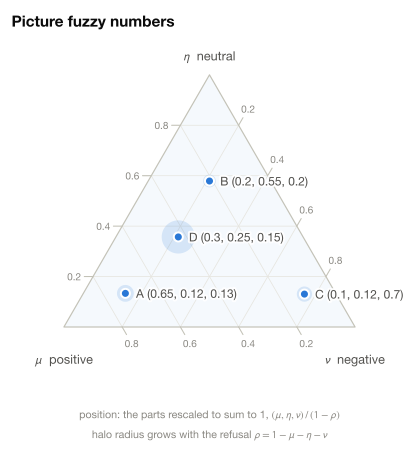
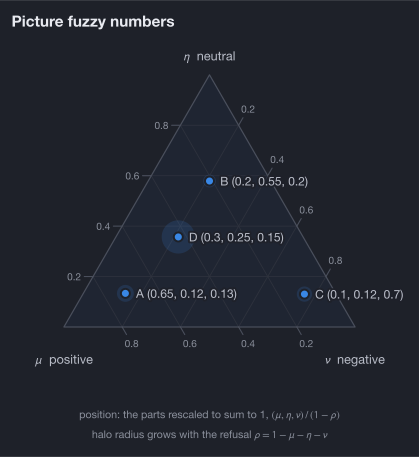
The operations are those of Wei (2017), as the code evaluates them (that paper was retracted by the publisher in 2025; the closed forms are tested against the code, not the paper, see the references):
| Operation | \(\mu\) | \(\eta\) | \(\nu\) |
|---|---|---|---|
add |
\(\mu_1 + \mu_2 - \mu_1 \mu_2\) | \(\eta_1 \eta_2\) | \(\nu_1 \nu_2\) |
mul |
\((\mu_1 + \eta_1)(\mu_2 + \eta_2) - \eta_1 \eta_2\) | \(\eta_1 \eta_2\) | \(\nu_1 + \nu_2 - \nu_1 \nu_2\) |
scale by \(k\) |
\(1 - (1 - \mu)^k\) | \(\eta^k\) | \(\nu^k\) |
power by \(k\) |
\((\mu + \eta)^k - \eta^k\) | \(\eta^k\) | \(1 - (1 - \nu)^k\) |
Scores: "difference" (default) \(\mu - \nu\) and "normalized"
\((1 + \mu - \nu)/2\). Accuracy "sum": \(\mu + \eta + \nu\).
Scaling by \(k < 1\) can leave the constraint set, and \(k = 0\) always does (the
additive identity \((0, 1, 1)\) is not a valid picture number). That matters
because averaging is built from scaling by weights below 1. So
wa and wg use closed forms for
picture numbers and work regardless.
from bulanik import PictureFN
from bulanik.aggregate import wa

a, b = PictureFN(0.5, 0.2, 0.1), PictureFN(0.4, 0.3, 0.2)
print(a, round(a.accuracy(), 4), "refusal", round(1 - sum(a.parts), 4))
print([round(p, 4) for p in (a + b).parts])
print([round(p, 4) for p in (a * b).parts])
print([round(p, 4) for p in (a ** 2).parts])
print(round(a.score(), 4), round(a.score("normalized"), 4))
print(a.complement())
mean = wa([a, b], [0.5, 0.5])          # closed form: no scale(0.5) involved
print([round(p, 4) for p in mean.parts])
PictureFN(mu=0.5, eta=0.2, nu=0.1) 0.8 refusal 0.2
[0.7, 0.06, 0.02]
[0.43, 0.06, 0.28]
[0.45, 0.04, 0.19]
0.4 0.7
PictureFN(mu=0.1, eta=0.2, nu=0.5)
[0.4523, 0.2449, 0.1414]
Neutrosophic numbers
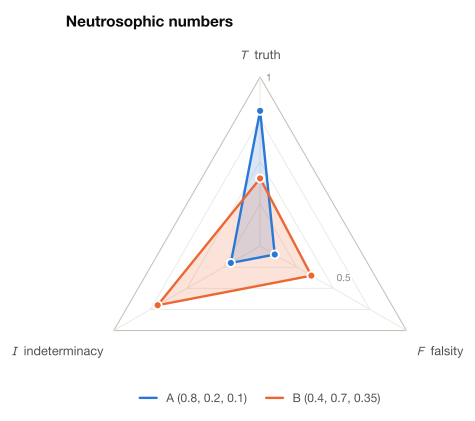
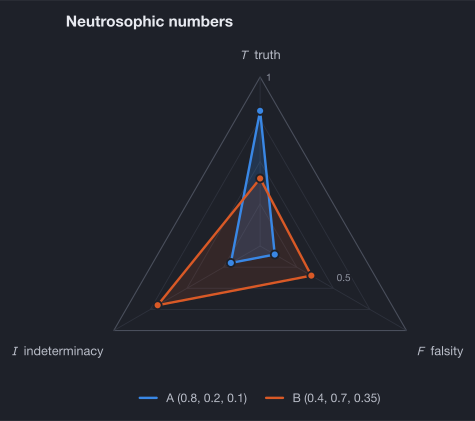
A single-valued neutrosophic number (Wang, Smarandache, Zhang and Sunderraman 2010) has no joint constraint, so truth, indeterminacy and falsity can each be anything in \([0, 1]\). Operations:
| Operation | \(t\) | \(i\) | \(f\) |
|---|---|---|---|
add |
\(t_1 + t_2 - t_1 t_2\) | \(i_1 i_2\) | \(f_1 f_2\) |
mul |
\(t_1 t_2\) | \(i_1 + i_2 - i_1 i_2\) | \(f_1 + f_2 - f_1 f_2\) |
scale by \(k\) |
\(1 - (1 - t)^k\) | \(i^k\) | \(f^k\) |
power by \(k\) |
\(t^k\) | \(1 - (1 - i)^k\) | \(1 - (1 - f)^k\) |
The only score is "average", \((2 + t - i - f)/3 \in [0, 1]\). Accuracy is
"difference" (default) \(t - f\) or "certainty" \(t\). The complement is
\((f, 1 - i, t)\) and distances divide by 3 instead of 2.
from bulanik import NeutrosophicFN

a, b = NeutrosophicFN(0.7, 0.2, 0.1), NeutrosophicFN(0.5, 0.3, 0.2)
print([round(p, 4) for p in (a + b).parts])
print([round(p, 4) for p in (a * b).parts])
print([round(p, 4) for p in a.scale(2).parts], [round(p, 4) for p in a.scale(0.5).parts])
print(round(a.score(), 4), a.accuracy(), a.accuracy("certainty"))
print(a.complement())
print(round(a.distance(b), 4), NeutrosophicFN(0.9, 0.9, 0.9))   # no joint constraint
[0.85, 0.06, 0.02]
[0.35, 0.44, 0.28]
[0.91, 0.04, 0.01] [0.4523, 0.4472, 0.3162]
0.8 0.6 0.7
NeutrosophicFN(t=0.1, i=0.8, f=0.7)
0.1333 NeutrosophicFN(t=0.9, i=0.9, f=0.9)
Pitfalls
Each type has its own constraint, and neutrosophic has none. A spherical number that is fine as a picture number may be rejected, and a neutrosophic number that is "too big" is accepted.
The three types do not mix, and none mixes with orthopair numbers.
Picture scale below 1. Never scale a picture number by a fraction by hand;
wa does it for you. scale(0.5) fails when the result leaves the set.
Tiny spherical parts. Spherical operations work on squares, so a part below about \(1.5 \times 10^{-154}\) behaves as 0.
from bulanik import IFN, NeutrosophicFN, PictureFN, SphericalFN

def show(make):
    try:
        print(make())
    except Exception as error:
        print(f"{type(error).__name__}: {error}")

show(lambda: SphericalFN(0.8, 0.5, 0.5))
show(lambda: PictureFN(0.6, 0.3, 0.3))
show(lambda: PictureFN(0.5, 0.2, 0.1).scale(0.5))
show(lambda: PictureFN(0.5, 0.2, 0.1).scale(0))
show(lambda: PictureFN(0.5, 0.2, 0.1).scale(-1))
show(lambda: PictureFN(0.5, 0.2, 0.1) + NeutrosophicFN(0.5, 0.2, 0.1))
show(lambda: SphericalFN(0.5, 0.4, 0.3) + IFN(0.5, 0.4))
show(lambda: NeutrosophicFN(0.7, 0.2, 0.1).score("normalized"))
show(lambda: SphericalFN(0.5, 0.4, 0.3).accuracy("difference"))
show(lambda: SphericalFN(0.5, 0.4, 0.3).add(SphericalFN(0.1, 0.1, 0.1), ops="einstein"))
ValueError: need mu^2 + nu^2 + pi^2 <= 1, got mu=0.8, nu=0.5, pi=0.5 (sum 1.1400000000000001)
ValueError: need mu + eta + nu <= 1, got mu=0.6, eta=0.3, nu=0.3 (sum 1.2)
ValueError: result violates mu + eta + nu <= 1 (sum 1.0563345803302484)
ValueError: result violates mu + eta + nu <= 1 (sum 2.0)
ValueError: scale needs k >= 0, got -1.0
TypeError: unsupported operand type(s) for +: 'PictureFN' and 'NeutrosophicFN'
TypeError: unsupported operand type(s) for +: 'SphericalFN' and 'IFN'
ValueError: unknown score 'normalized' for NeutrosophicFN; valid: average
ValueError: unknown accuracy 'difference' for SphericalFN; valid: sum
ValueError: unknown ops 'einstein' for SphericalFN; valid: algebraic
See also
- Orthopair numbers for the two-degree types.
- Choosing a method and Conventions.
- Aggregation for closed-form picture averages.
- API:
SphericalFN,PictureFN,NeutrosophicFN.