Interval type-2 inference
A type-1 membership function says "the temperature 22 is warm to degree 0.7", with the 0.7 exact. An interval type-2 (IT2) set admits that the 0.7 is itself uncertain: it gives each \(x\) an interval of degrees \([\underline{\mu}(x), \overline{\mu}(x)]\). The region between the lower and the upper curve is the footprint of uncertainty (FOU). Use it when experts disagree about where a term starts and ends, or when you want a controller that is less sensitive to noisy inputs than a single sharp curve.
Interval sets
An IT2MF is built from two type-1 functions, upper and
lower; calling it returns the pair (lower, upper). Three builders cover the common
cases:
| Builder | Upper bound | Lower bound |
|---|---|---|
gaussian_uncertain_mean(m1, m2, sigma) |
1 on \([m_1, m_2]\), the Gaussian of the nearer mean outside | \(\min\bigl(g(x; m_1), g(x; m_2)\bigr)\) |
gaussian_uncertain_sigma(mean, s1, s2) |
Gaussian with the wider \(\sigma_2\) | Gaussian with the narrower \(\sigma_1\) |
scaled_triangle(a, b, c, h) |
triangle \((a, b, c)\) | the same triangle scaled to height \(h\) |
Here \(g(x; m) = \exp\bigl(-(x - m)^2 / (2\sigma^2)\bigr)\).
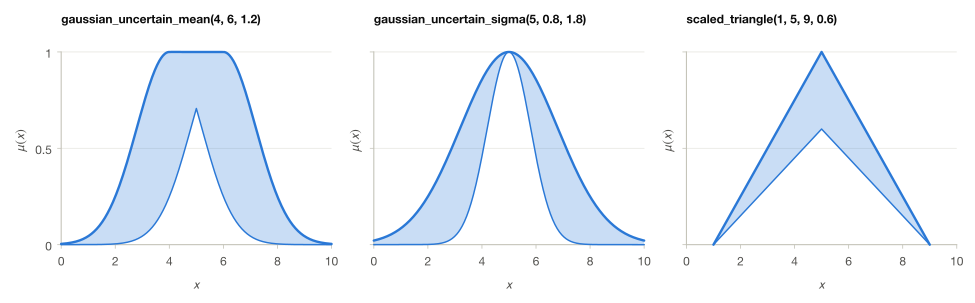
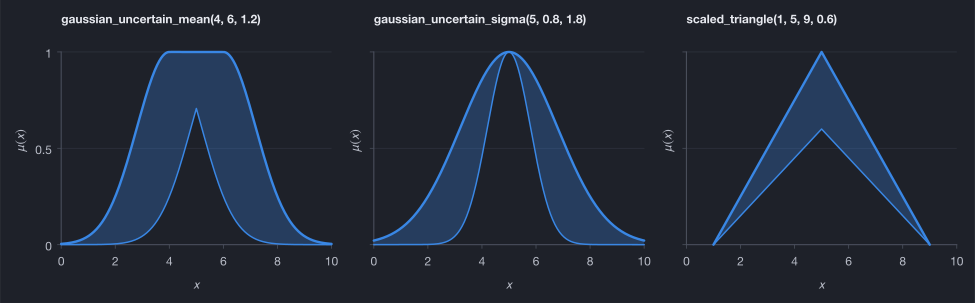
plot.it2_set.A lower bound above the upper bound at any \(x\) is an error (ValueError, raised when that
\(x\) is evaluated; float noise within \(10^{-12}\) is clamped). An
IT2LinguisticVariable groups IT2 terms on a
universe; from_type1 turns a type-1
variable into one with no uncertainty (lower equals upper).
from bulanik.type2 import (IT2LinguisticVariable, gaussian_uncertain_mean, scaled_triangle)

mf = gaussian_uncertain_mean(4, 6, 1.2)
print(mf(5), mf(8))                      # (lower, upper) at two points
x = IT2LinguisticVariable("x", (0, 10), {
    "lo": scaled_triangle(0, 0, 10, 0.5), "hi": scaled_triangle(0, 10, 10, 0.5)})
print(x.fuzzify(2))
print(x)
(0.7066482778577162, 1.0) (0.003865920139472804, 0.24935220877729616)
{'lo': (0.4, 0.8), 'hi': (0.1, 0.2)}
IT2LinguisticVariable('x', (0.0, 10.0), terms=('lo', 'hi'))
Type reduction
Fuzzy inference with IT2 sets does not produce one number. Each rule fires with an
interval \([\underline{f}, \overline{f}]\): the antecedent is evaluated once with the lower
bounds and once with the upper bounds (NOT maps \([a, b]\) to \([1 - b, 1 - a]\)), and the
rule weight multiplies both. The result is a set of points \(y_i\) whose weights \(w_i\) are
only known to lie in intervals. Type reduction turns that into an interval
\([y_l, y_r]\) of possible crisp outputs, and the system returns its midpoint (the
output).
type_reduce works directly on points with interval weights
\(w_i \in [\underline{w}_i, \overline{w}_i]\). The centroid interval is
and the four methods are:
| Method | What it computes | Use it when |
|---|---|---|
"km" (Karnik and Mendel 2001) |
the exact \([y_l, y_r]\) by iterating a switch point over the \(y\)-sorted samples; output \((y_l + y_r)/2\) | you want the reference answer; the default |
"ekm" (Wu and Mendel 2009) |
the same endpoints, with a better starting switch point and incremental sums | many samples; the endpoints agree with km up to rounding (about 1 ulp) |
"nie_tan" (Nie and Tan 2008) |
closed form \(\sum_i y_i(\underline{w}_i + \overline{w}_i) / \sum_i(\underline{w}_i + \overline{w}_i)\); left == right == output |
you need speed and no iteration, and do not need the interval |
"bmm" (Begian, Melek and Mendel 2008) |
\(m\,\bar{y}_\text{lower} + n\,\bar{y}_\text{upper}\), the weighted averages with the lower and with the upper weights; \(m = n = 0.5\) by default | you want a cheap, smooth approximation; needs some positive lower weight |
On plateaus (equal \(y\) or equal weights) km and ekm may stop at different, equally
optimal switch indices; the endpoints are the same. bmm_m and bmm_n have only to be
finite; neither sign nor \(m + n = 1\) is enforced, so the output of bmm can fall outside
\([y_l, y_r]\) for unusual factors.
from bulanik.type2 import type_reduce

ys, lower, upper = [1, 2, 3], [0.2, 0.3, 0.1], [0.6, 0.8, 0.5]
for method in ("km", "ekm", "nie_tan", "bmm"):
    r = type_reduce(ys, lower, upper, method)
    print(f"{method:8s} [{r.left:.4f}, {r.right:.4f}]  output {r.output:.4f}  "
          f"switches {r.left_switch}, {r.right_switch}")
print(type_reduce(ys, [0.5] * 3, [0.5] * 3).output)   # no uncertainty: the plain weighted mean
km       [1.5000, 2.3000]  output 1.9000  switches 1, 2
ekm      [1.5000, 2.3000]  output 1.9000  switches 1, 2
nie_tan  [1.9200, 1.9200]  output 1.9200  switches None, None
bmm      [1.8333, 1.9474]  output 1.8904  switches None, None
2.0
left_switch and right_switch are the 1-based positions in the sorted samples where
the left end changes from upper to lower weights (right end: lower to upper); they are
None for the closed-form methods.
The IT2 systems
IT2MamdaniFIS and
IT2SugenoFIS use the same rule language and options as
their type-1 counterparts, plus type_reduction (default "km").
- IT2 Mamdani. Each output universe is sampled at
resolutionpoints (default 1001). The upper and the lower aggregated sets are \(\overline{\mu}(x_i) = \operatorname{agg}_k \operatorname{imp}(\overline{f}_k, \overline{\mu}_{B_k}(x_i))\) and \(\underline{\mu}(x_i) = \operatorname{agg}_k \operatorname{imp}(\underline{f}_k, \underline{\mu}_{B_k}(x_i))\), andtype_reduce(xs, lower, upper, method)gives the interval. - IT2 Sugeno. Outputs are ordinary
SugenoOutputterms (constants orLinear), so the points \(y_i = z_k\) are crisp and the weights are the firing intervals:type_reduce([z_k], [f_lower_k], [f_upper_k]).
evaluate returns the crisp outputs; evaluate_interval returns a
TypeReduced per output (with left, right, output and
the switch points); explain returns the usual Explanation, whose degrees and rule
activations hold (lower, upper) pairs.
from bulanik.inference import SugenoOutput
from bulanik.type2 import (IT2LinguisticVariable, IT2MamdaniFIS, IT2SugenoFIS,
                           scaled_triangle)

x = IT2LinguisticVariable("x", (0, 10), {
    "lo": scaled_triangle(0, 0, 10, 0.5), "hi": scaled_triangle(0, 10, 10, 0.5)})
tip = IT2LinguisticVariable("tip", (0, 20), {
    "low": scaled_triangle(0, 0, 10, 0.6), "high": scaled_triangle(10, 20, 20, 0.6)})
mamdani = IT2MamdaniFIS([x], [tip], [
    "IF x IS lo THEN tip IS low", "IF x IS hi THEN tip IS high"], resolution=201)
r = mamdani.evaluate_interval({"x": 7})["tip"]
print(f"Mamdani  [{r.left:.2f}, {r.right:.2f}]  output {r.output:.3f}")

y = SugenoOutput("y", {"a": 0.0, "b": 10.0})
sugeno = IT2SugenoFIS([x], [y], ["IF x IS lo THEN y IS a", "IF x IS hi THEN y IS b"])
info = sugeno.explain({"x": 7})
print(info.degrees["x"])
print([a.strength for a in info.activations], info.outputs)
Mamdani  [10.20, 13.83]  output 12.010
{'lo': (0.15, 0.3), 'hi': (0.35, 0.7)}
[(0.15, 0.3), (0.35, 0.7)] {'y': 6.809954751131222}
With no uncertainty (lower equal to upper everywhere) the IT2 system reproduces its type-1 version exactly; this is a good sanity check when you build a model.
from bulanik.inference import SugenoFIS, SugenoOutput
from bulanik.sets import LinguisticVariable, gaussian
from bulanik.type2 import IT2LinguisticVariable, IT2SugenoFIS

t1 = LinguisticVariable("x", (0, 10), {"lo": gaussian(0, 2), "hi": gaussian(10, 2)})
y = SugenoOutput("y", {"a": 0.0, "b": 10.0})
rules = ["IF x IS lo THEN y IS a", "IF x IS hi THEN y IS b"]
print(SugenoFIS([t1], [y], rules).evaluate({"x": 3}))
print(IT2SugenoFIS([IT2LinguisticVariable.from_type1(t1)], [y], rules).evaluate({"x": 3}))
{'y': 0.06692850924284856}
{'y': 0.06692850924284856}
For the whole input-output map use plot.surface, which accepts
the IT2 systems too (and shows a gap where NoRuleFiredError or NoLowerFiringError
would be raised). The example 14 IT2 vs T1 noise
compares an IT2 and a type-1 Sugeno approximator on noisy inputs; read its caveat: a
wider type-1 term is also less noise-sensitive, so IT2 is not a free robustness win.
Defaults and the missing-rule cases
- No rule fires (every upper firing is 0):
defaultis returned, orNoRuleFiredErroris raised, with.explanationas in type-1. An IT2defaultis a number or a(left, right)pair (the interval to report; the output is its midpoint). type_reduction="bmm"with no lower firing. BMM needs some rule with a positive lower firing: the rules fire possibly (upper \(> 0\)) but nowhere with certainty. ThenNoLowerFiringError(aValueError) is raised, naming the output. Use"km","ekm"or"nie_tan"instead, or widen the lower sets.
from bulanik.inference import NoRuleFiredError, SugenoOutput
from bulanik.sets import triangular
from bulanik.type2 import IT2MF, IT2LinguisticVariable, IT2SugenoFIS, NoLowerFiringError

# wide upper bound, narrow lower bound: at x = 3 the rule can fire (upper > 0) but not for sure
mid = IT2MF(upper=triangular(2, 5, 8), lower=triangular(4, 5, 6))
x = IT2LinguisticVariable("x", (0, 10), {"mid": mid})
y = SugenoOutput("y", {"a": 1.0})
rules = ["IF x IS mid THEN y IS a"]

for point in (5.0, 3.0, 9.5):
    for method in ("km", "bmm"):
        fis = IT2SugenoFIS([x], [y], rules, type_reduction=method)
        try:
            print(point, method, fis.evaluate({"x": point}))
        except (NoRuleFiredError, NoLowerFiringError) as error:
            print(point, method, type(error).__name__)
print(x.fuzzify(5.0), x.fuzzify(3.0), x.fuzzify(9.5))
print(IT2SugenoFIS([x], [y], rules, default={"y": (0, 2)}).evaluate_interval({"x": 9.5}))
5.0 km {'y': 1.0}
5.0 bmm {'y': 1.0}
3.0 km {'y': 1.0}
3.0 bmm NoLowerFiringError
9.5 km NoRuleFiredError
9.5 bmm NoRuleFiredError
{'mid': (1.0, 1.0)} {'mid': (0.0, 0.3333333333333333)} {'mid': (0.0, 0.0)}
{'y': TypeReduced(left=0.0, right=2.0, output=1.0, left_switch=None, right_switch=None)}
Pitfalls
Lower must stay below upper. A hand-built IT2MF whose lower exceeds its upper at
some \(x\) raises ValueError when evaluated, not at construction. The three builders
cannot violate it; for your own pairs, check with plot.it2_set or evaluate a grid.
Error messages use internal kind names. gaussian_flat_top is the upper bound of
gaussian_uncertain_mean, gaussian_min_pair its lower bound, and scaled_triangular the
lower bound of scaled_triangle.
Parameter order is checked. gaussian_uncertain_mean needs \(m_1 \le m_2\) and
\(\sigma > 0\); gaussian_uncertain_sigma needs \(0 < \sigma_1 \le \sigma_2\);
scaled_triangle needs ordered points and a height in \((0, 1]\).
Weights are validated by type_reduce. Negative weights, lower above upper, unequal
lengths, non-finite values and all-zero upper weights raise ValueError; a bool or a
string is a TypeError.
The output is a midpoint, not a probability or a most-likely value; report
evaluate_interval when the width of \([y_l, y_r]\) matters, since it is the system's own
measure of how uncertain the answer is.
from bulanik.type2 import (IT2MF, gaussian_uncertain_mean, gaussian_uncertain_sigma,
                           scaled_triangle, type_reduce)
from bulanik.sets import triangular

def show(make):
    try:
        print(make())
    except Exception as error:
        print(f"{type(error).__name__}: {error}")

show(lambda: IT2MF(upper=triangular(2, 5, 8), lower=triangular(0, 5, 10))(1))
show(lambda: gaussian_uncertain_mean(6, 4, 1))
show(lambda: gaussian_uncertain_sigma(5, 2, 1))
show(lambda: scaled_triangle(0, 5, 10, 1.5))
show(lambda: type_reduce([1, 2], [0.5], [0.6, 0.7]))
show(lambda: type_reduce([1, 2], [0.9, 0.1], [0.5, 0.7]))
show(lambda: type_reduce([1, 2], [0, 0], [0, 0]))
show(lambda: type_reduce([1, 2], [0, 0], [1, 1], "bmm"))
show(lambda: type_reduce([1, 2], [0, 0], [1, 1], "karnik"))
ValueError: lower membership 0.2 exceeds upper membership 0 at x=1
ValueError: gaussian_flat_top needs m1 <= m2 and sigma > 0, got (6.0, 4.0, 1.0)
ValueError: gaussian_uncertain_sigma needs 0 < sigma_low <= sigma_high, got 2, 1
ValueError: scaled_triangular needs a <= b <= c and a < c and 0 < height <= 1, got (0.0, 5.0, 10.0, 1.5)
ValueError: ys, lower and upper must have the same length, got 2, 1, 2
ValueError: lower weight 0.9 exceeds upper weight 0.5 at position 0
ValueError: cannot type-reduce: the upper weights are all zero
NoLowerFiringError: bmm needs a positive lower weight somewhere (every lower weight is 0); use 'km', 'ekm' or 'nie_tan' instead
ValueError: unknown type reduction method 'karnik' for type_reduce; valid: km, ekm, nie_tan, bmm
See also
- Mamdani inference and Sugeno and Tsukamoto for the type-1 systems that these generalise.
- Sets and scales for type-1 variables.
- API:
bulanik.type2,bulanik.plot. - Example: 14 IT2 vs T1 noise.
- Mendel (2001), Uncertain Rule-Based Fuzzy Logic Systems: Introduction and New Directions; Karnik and Mendel (2001), "Centroid of a type-2 fuzzy set", Information Sciences; Wu and Mendel (2009), "Enhanced Karnik-Mendel algorithms", IEEE Transactions on Fuzzy Systems; Nie and Tan (2008), "Towards an efficient type-reduction method for interval type-2 fuzzy logic systems", FUZZ-IEEE; Begian, Melek and Mendel (2008), "Stability analysis of type-2 fuzzy systems", FUZZ-IEEE (the BMM type reducer).