Triangular and trapezoidal numbers
A triangular fuzzy number (TFN) is a vague quantity such as
"about 4, certainly between 2 and 7". It is three numbers \((l, m, u)\): the
lower foot, the peak and the upper foot. A trapezoidal fuzzy number
(TrFN) has four, \((a, b, c, d)\): a plateau \([b, c]\) of fully
plausible values instead of a single peak. Use them when your input is a
measurement with a spread, an interval estimate, or a linguistic rating such as
"good" that you have mapped to a range.
The idea
The membership degree \(\mu(x) \in [0, 1]\) says how well the crisp value \(x\) fits the number. For a triangle it rises linearly from 0 at \(l\) to 1 at \(m\) and falls back to 0 at \(u\). For a trapezoid it stays 1 on the whole plateau.
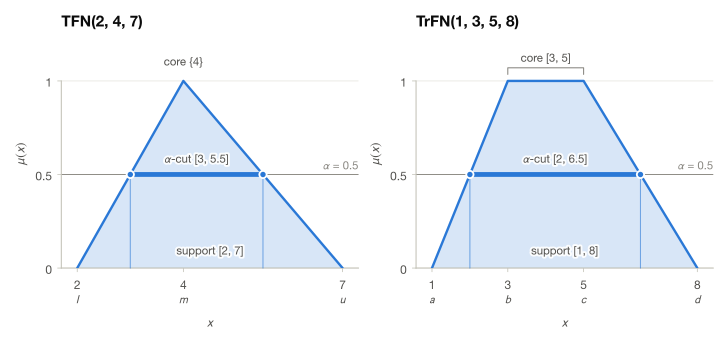
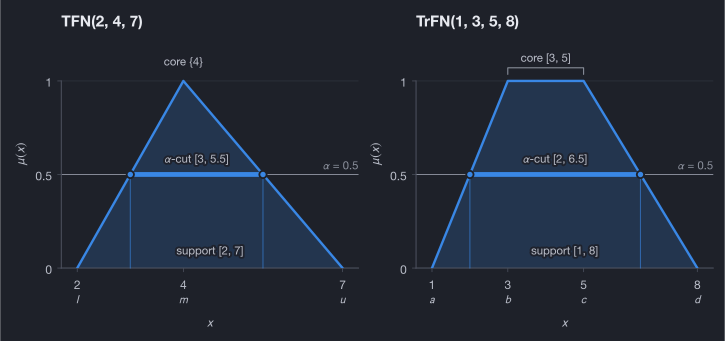
Two rules govern the points, and the constructor checks both: every point is a
finite real number (a bool or a string is a TypeError), and the points are
ordered, \(l \le m \le u\) or \(a \le b \le c \le d\). Equal points are allowed, so
TFN(5, 5, 5) is the crisp number 5 and TFN(0, 0, 5) has a vertical left edge.
from bulanik import TFN, TrFN

a = TFN(1, 2, 4)
t = TrFN(1, 2, 3, 5)
print(a, t, sep="\n")                  # points are stored as floats
print(a.l, a.m, a.u)
print(a.mu(1.5), a.mu(3), a.mu(9))     # membership: rising edge, falling edge, outside
print(t.mu(2.5))                       # on the plateau
print(a.to_trfn())                     # a TFN is a trapezoid with a one-point core
print(TFN(5, 5, 5).score())            # a crisp number is a degenerate triangle
TFN(l=1.0, m=2.0, u=4.0) TrFN(a=1.0, b=2.0, c=3.0, d=5.0)
1.0 2.0 4.0
0.5 0.5 0.0
1.0
TrFN(a=1.0, b=2.0, c=2.0, d=4.0)
5.0
α-cuts
The α-cut \(\{x : \mu(x) \ge \alpha\}\) of a triangle or trapezoid is always an interval. With support \([p_0, p_n]\) and core \([c_\text{lo}, c_\text{hi}]\) the code computes
At \(\alpha = 0\) this is the support and at \(\alpha = 1\) the core. α-cuts are the bridge to interval arithmetic: fuzzy arithmetic is interval arithmetic carried out at every level.
from bulanik import TFN, TrFN

a = TFN(1, 2, 4)
for alpha in (0, 0.5, 1):
    print(alpha, a.alpha_cut(alpha))
print(TrFN(1, 2, 3, 5).alpha_cut(1))   # the plateau
0 (1.0, 4.0)
0.5 (1.5, 3.0)
1 (2.0, 2.0)
(2.0, 3.0)
Arithmetic
The operators + - * /, ** and unary - use the only operator family,
"algebraic"; the methods add, sub, mul, scale, power and
reciprocal do the same and take an ops= argument that only accepts that name.
Every operation returns a new number of the same type and combines TFN with
TFN and TrFN with TrFN. The code is the standard approximate arithmetic on
the defining points:
| Operation | Result, for a triangle \((l_1, m_1, u_1)\) and \((l_2, m_2, u_2)\) |
|---|---|
A + B |
\((l_1 + l_2,\; m_1 + m_2,\; u_1 + u_2)\) |
A - B |
\((l_1 - u_2,\; m_1 - m_2,\; u_1 - l_2)\): each point against the opposite point of \(B\) |
A * B |
outer points are the smallest and largest of the four products \(l_1 l_2,\, l_1 u_2,\, u_1 l_2,\, u_1 u_2\); the inner points are the products of the inner points, sorted. For non-negative numbers this is \((l_1 l_2,\; m_1 m_2,\; u_1 u_2)\) |
k * A, A * k, A / k |
every point times \(k\) (or \(1/k\)); for \(k < 0\) the points are also reversed so the order is kept |
A ** k |
every point to the power \(k\); reversed for \(k < 0\); needs the lowest point \(\ge 0\) (and \(> 0\) for \(k < 0\)) |
A.reciprocal() |
\((1/u,\; 1/m,\; 1/l)\); the support must not contain 0 |
A / B |
A * B.reciprocal() |
A trapezoid works the same way on its four points. The sum and the difference are
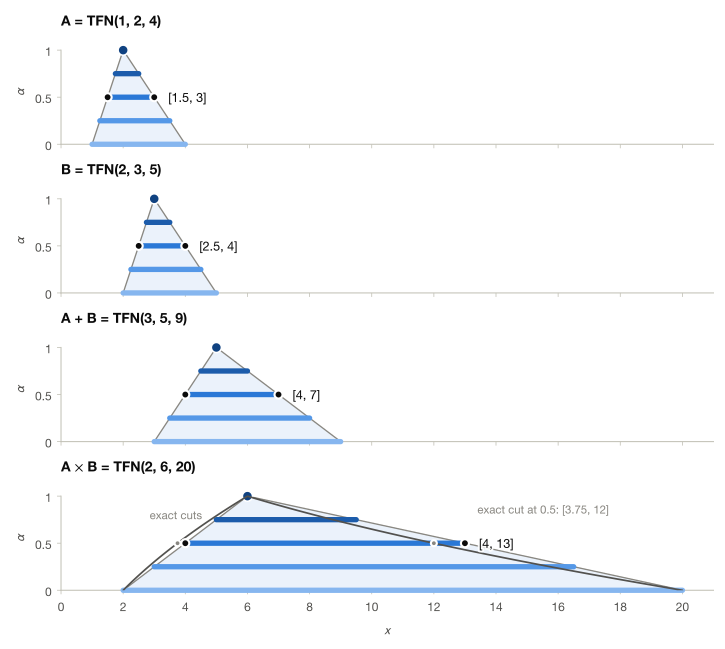
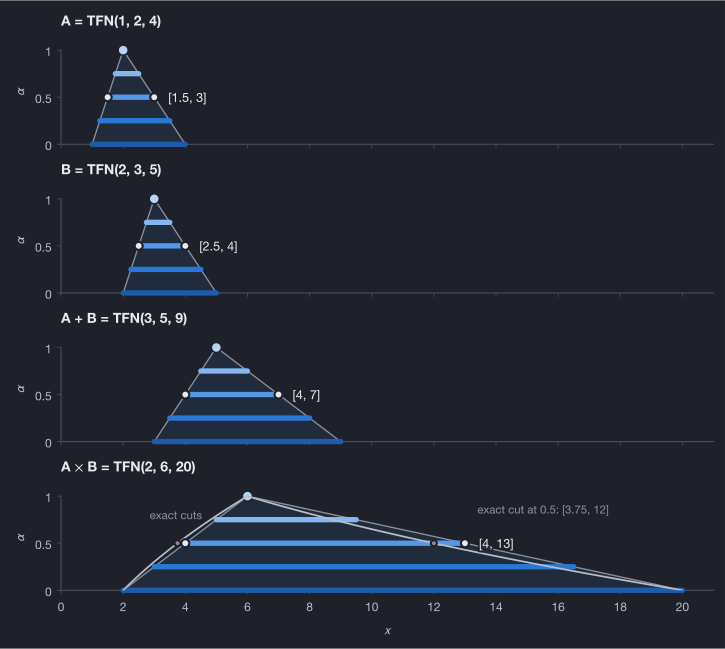
exact in the sense of α-cuts (the cut of \(A + B\) is the sum of the cuts). The
product and the quotient are approximations: the exact product of two
triangles has curved sides, and A * B returns the triangle through its corner
products. The two agree at \(\alpha = 0\) and \(\alpha = 1\) but not in between, and
the triangle is not simply wider or narrower: for the example below, at
\(\alpha = 0.5\) the exact cut is \([3.75, 12]\) and the triangle's is \([4, 13]\), so it
is inside at the lower end and outside at the upper end.
from bulanik import TFN

a, b = TFN(1, 2, 4), TFN(2, 3, 5)
print("a + b  =", a + b)
print("a - b  =", a - b)
print("a * b  =", a * b)
print("a / b  =", a / b)
print("2 * a  =", 2 * a, "| -a =", -a)             # a negative factor reverses the points
print("a ** 2 =", a ** 2)
print("1 / a  =", a.reciprocal())
print(a.add(b, ops="algebraic"))                   # the only valid name
a + b  = TFN(l=3.0, m=5.0, u=9.0)
a - b  = TFN(l=-4.0, m=-1.0, u=2.0)
a * b  = TFN(l=2.0, m=6.0, u=20.0)
a / b  = TFN(l=0.2, m=0.6666666666666666, u=2.0)
2 * a  = TFN(l=2.0, m=4.0, u=8.0) | -a = TFN(l=-4.0, m=-2.0, u=-1.0)
a ** 2 = TFN(l=1.0, m=4.0, u=16.0)
1 / a  = TFN(l=0.25, m=0.5, u=1.0)
TFN(l=3.0, m=5.0, u=9.0)
Scores, defuzzification and distance
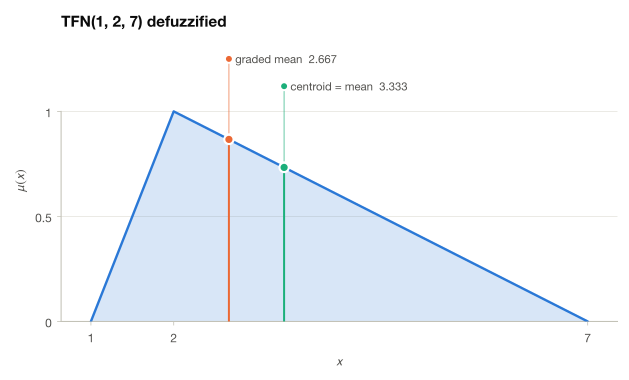
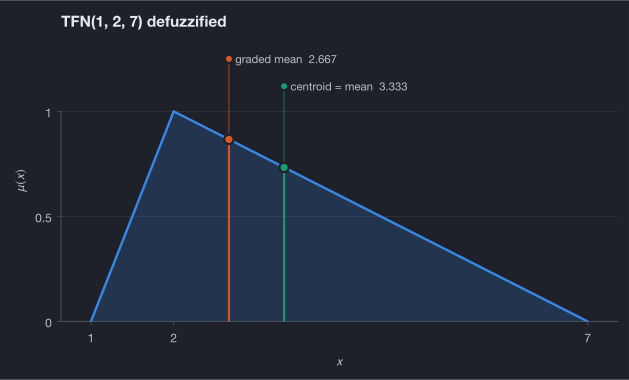
To rank numbers you need one crisp value per number. score(method) (and its
synonym defuzzify(method)) offers three, the default being the centroid:
| Method | Triangle \((l, m, u)\) | Trapezoid \((a, b, c, d)\) |
|---|---|---|
"centroid" (default) |
\((l + m + u)/3\) | \(\dfrac{d^2 + c^2 + cd - a^2 - b^2 - ab}{3\,(d + c - a - b)}\) |
"graded_mean" |
\((l + 4m + u)/6\) | \((a + 2b + 2c + d)/6\) |
"mean" |
\((l + m + u)/3\), the same as the centroid | \((a + b + c + d)/4\) |
The only distance is "vertex" (Chen 2000): the root mean square of the point
differences,
with \(n = 3\) for triangles and \(n = 4\) for trapezoids. Fuzzy TOPSIS
(fuzzy_topsis) uses it. Triangular numbers have
no accuracy function: ties between equal scores are not broken by a second
quantity.
from bulanik import TFN, TrFN

a = TFN(1, 2, 7)
for method in TFN.SCORES:
    print(f"{method:12s} {a.score(method):.4f}")
print(a.score() == a.score("centroid"), a.defuzzify("graded_mean") == a.score("graded_mean"))

t = TrFN(1, 2, 3, 5)
print({m: round(t.score(m), 4) for m in TrFN.SCORES})
print(TFN(1, 2, 4).distance(TFN(2, 3, 5)))           # sqrt(((1-2)^2 + (2-3)^2 + (4-5)^2) / 3)
centroid     3.3333
graded_mean  2.6667
mean         3.3333
True True
{'centroid': 2.8, 'graded_mean': 2.6667, 'mean': 2.75}
1.0
Drawing them
bulanik.plot (the plot extra) draws membership functions,
α-cuts and defuzzification markers; the figures above come from it. The
gallery shows more.
Pitfalls
Points must be ordered, finite and real numbers. Swapped points, NaN, a bool
or a string are rejected when the number is built, so a bad TFN never exists.
Numbers of different types do not mix. A TFN is not a TrFN, and neither
is an IFN. Convert a triangle with to_trfn(). A plain number is not a fuzzy
number either: TFN + 1 fails, so write TFN + TFN(1, 1, 1). Only
multiplication, division and ** accept a plain number.
Reciprocal, division and powers need a safe support. The support, endpoints
included, must not contain 0 for reciprocal() and /, and the lowest point must be non-negative
for **.
Multiplication is an approximation. A * B is not the exact product of the
fuzzy sets, only the standard point-based one (see the figure above). If you need
exact products, work on α-cuts with interval arithmetic yourself.
Score names and accuracy. accuracy() always raises, and an unknown score
name lists the valid ones.
from bulanik import IFN, TFN, TrFN

def show(make):
    try:
        print(make())
    except Exception as error:
        print(f"{type(error).__name__}: {error}")

show(lambda: TFN(3, 2, 1))                      # points out of order
show(lambda: TFN(1, 2, float("inf")))           # not finite
show(lambda: TFN(True, 2, 3))                   # a bool is not a number
show(lambda: TFN(1, 2, 3) + TrFN(1, 2, 3, 4))   # different types
show(lambda: TFN(1, 2, 3) + IFN(0.5, 0.4))
show(lambda: TFN(1, 2, 3) + 1)                  # a plain number is not a fuzzy number
show(lambda: TFN(-1, 0, 1).reciprocal())        # the support contains 0
show(lambda: TFN(0, 1, 2).reciprocal())         # a zero endpoint counts too
show(lambda: TFN(1, 2, 3) / TFN(-1, 0, 1))
show(lambda: TFN(-1, 2, 4) ** 2)                # negative lowest point
show(lambda: TFN(1, 2, 3).score("median"))
show(lambda: TFN(1, 2, 3).accuracy())
show(lambda: TFN(1, 2, 3).add(TFN(1, 2, 3), ops="einstein"))
ValueError: TFN needs l <= m <= u, got (3.0, 2.0, 1.0)
ValueError: u must be finite, got inf
TypeError: l must be a number, got bool True
TypeError: unsupported operand type(s) for +: 'TFN' and 'TrFN'
TypeError: unsupported operand type(s) for +: 'TFN' and 'IFN'
TypeError: unsupported operand type(s) for +: 'TFN' and 'int'
ValueError: cannot take the reciprocal of TFN(l=-1.0, m=0.0, u=1.0): its support contains 0
ValueError: cannot take the reciprocal of TFN(l=0.0, m=1.0, u=2.0): its support contains 0
ValueError: cannot take the reciprocal of TFN(l=-1.0, m=0.0, u=1.0): its support contains 0
ValueError: power 2.0 needs the lowest point >= 0, got -1.0
ValueError: unknown score 'median' for TFN; valid: centroid, graded_mean, mean
ValueError: TFN has no accuracy function
ValueError: unknown ops 'einstein' for TFN; valid: algebraic
See also
- Conventions: validation, immutability and the
naming rule behind
ops=andscore(method). - Choosing a method: when triangles are enough and when an orthopair or three-part number fits better.
- Aggregation to combine several triangles, and Sets and scales for linguistic terms.
- Fuzzy TOPSIS, which ranks triangles with the vertex distance.
- API:
TFN,TrFN,bulanik.numbers. - Examples: 01 fuzzy numbers and 03 fuzzy AHP.