Ranking alternatives
Given alternatives rated on several criteria, a ranking method scores each alternative
and orders them. bulanik has four classical methods on a crisp matrix,
topsis, vikor,
waspas and edas, and
rank_fuzzy, which first turns fuzzy expert ratings
into that crisp matrix. Chen's fuzzy TOPSIS, which stays fuzzy throughout, has
its own page.
The common signature
The four crisp methods differ only in one extra parameter:
method(matrix, weights, criteria_types, *, alternatives=None, criteria=None,
       normalize_weights=False)
matrix: rows are alternatives, columns are criteria, all finite numbers.criteria_types:"benefit"(larger is better) or"cost"(smaller is better), one per column.weights: in any of four forms: a sequence in column order, a mapping from criterion name to weight, or aWeightingResultorBWMResultstraight from a weighting method. They must sum to 1 unlessnormalize_weights=True, which rescales non-negative weights instead.alternativesandcriteria: names. Alternatives default toA1..Am. Criteria are inferred: fromcriteria=if given, else from the keys of a mapping or result, elseC1..Cn(a plain sequence carries no names). A mapping or result must name every criterion and no other.
The result is a RankingResult with scores
(a dict), ranking (alternatives, best first; ties keep input order), operators (the
normalisation and distance or parameter used) and extras (per-alternative intermediate
values).
from bulanik.mcdm import swara, topsis

criteria = ["price", "quality", "delivery"]
types = ["cost", "benefit", "benefit"]
suppliers = ["Atlas", "Borealis", "Cedar", "Delta"]
data = [[120, 8, 7], [100, 7, 5], [110, 9, 6], [130, 6, 9]]

w = swara([0.2, 0.5], criteria)             # a WeightingResult carries the criteria names
a = topsis(data, w, types, alternatives=suppliers)
b = topsis(data, w.weights, types, alternatives=suppliers)                       # mapping
c = topsis(data, list(w.weights.values()), types, alternatives=suppliers)        # sequence
print(a.ranking, a.scores == b.scores == c.scores)
print({k: round(v, 4) for k, v in a.scores.items()})
print(a.operators, sorted(a.extras))

# raw importances 5 : 3 : 2 instead of weights summing to 1
d = topsis(data, [5, 3, 2], types, alternatives=suppliers, normalize_weights=True)
print(d.ranking)
('Cedar', 'Atlas', 'Delta', 'Borealis') True
{'Atlas': 0.5231, 'Borealis': 0.4199, 'Cedar': 0.5978, 'Delta': 0.4338}
{'normalization': 'vector', 'distance': 'euclidean'} ['d_minus', 'd_plus']
('Cedar', 'Borealis', 'Atlas', 'Delta')
Every method here works on the numbers as given: the scales of the columns are normalised away inside each method, so you can mix euros and ratings.
TOPSIS
TOPSIS (Hwang and Yoon 1981) prefers the alternative closest to the ideal solution and farthest from the anti-ideal. Each column is divided by its Euclidean norm and multiplied by the weight, \(v_{ij} = w_j x_{ij} / \sqrt{\sum_i x_{ij}^2}\). The ideal \(v_j^+\) is the column maximum for a benefit and the minimum for a cost (the anti-ideal \(v_j^-\) the reverse). With Euclidean distances \(D_i^+\) and \(D_i^-\) to them, the score is the relative closeness
and larger is better (0.5 when both distances are 0, that is, all alternatives are
equal). extras holds d_plus and d_minus. A column of zeros contributes 0.
VIKOR
VIKOR (Opricovic and Tzeng 2004) looks for a compromise: it balances the overall distance to the best values (group utility) against the worst single shortfall (individual regret). With \(f_j^*\) and \(f_j^-\) the best and worst value of criterion \(j\),
and the compromise index, with \(S^* = \min S\), \(S^- = \max S\) and likewise for \(R\),
Criteria with \(f_j^* = f_j^-\) are skipped and a term whose range is 0 counts as 0. The
parameter v in \([0, 1]\) (default 0.5, the usual consensus) is the weight of the group
utility strategy: raise it to favour the overall average, lower it to punish a single bad
criterion. extras holds S and R.
VIKOR scores are lower-is-better
For VIKOR the scores are \(Q\), and the smallest is best. The ranking tuple is
already ordered that way, and so is plot.ranking, which
labels the axis "lower is better". Use ranking, not a sort of scores. The
compromise-acceptability conditions C1 and C2 of the original method are not
checked.
WASPAS
WASPAS (Zavadskas et al. 2012) blends two aggregations. Entries are normalised linearly, \(\bar x_{ij} = x_{ij} / \max_i x_{ij}\) for a benefit and \(\min_i x_{ij} / x_{ij}\) for a cost, and
the weighted sum model plus the weighted product model, larger is better. The parameter
is lam (default 0.5): \(\lambda = 1\) is the pure weighted sum, \(\lambda = 0\) the pure
product. extras holds wsm and wpm. Entries must be strictly positive (the
product and the ratios need it).
EDAS
EDAS (Keshavarz Ghorabaee et al. 2015) scores each alternative by its distance from the average solution rather than from an extreme. With the column average \(\bar x_j\), the positive and negative distances from average of a benefit criterion are
swapped for a cost criterion. The weighted sums are \(SP_i = \sum_j w_j PDA_{ij}\) and
\(SN_i = \sum_j w_j NDA_{ij}\), normalised to \(NSP_i = SP_i / \max SP\) and
\(NSN_i = 1 - SN_i / \max SN\) (0 and 1 when the maximum is 0), and the appraisal score is
\((NSP_i + NSN_i)/2 \in [0, 1]\), larger is better. extras holds SP, SN, NSP, NSN.
Each column average must be positive.
Comparing the methods
The methods answer subtly different questions, so on a close call they can disagree. Run several on the same data and weights; the alternative that wins everywhere is a safe choice.
from bulanik.mcdm import edas, topsis, vikor, waspas

criteria = ["price", "quality", "delivery"]
types = ["cost", "benefit", "benefit"]
suppliers = ["Atlas", "Borealis", "Cedar", "Delta"]
data = [[120, 8, 7], [100, 7, 5], [110, 9, 6], [130, 6, 9]]
w = {"price": 0.4186, "quality": 0.3488, "delivery": 0.2326}

for method in (topsis, vikor, waspas, edas):
    r = method(data, w, types, alternatives=suppliers)
    print(f"{r.method:7}", r.ranking, {k: round(v, 3) for k, v in r.scores.items()})

for v in (0.0, 0.5, 1.0):                       # VIKOR: regret only .. utility only (no change here)
    print("v =", v, vikor(data, w, types, alternatives=suppliers, v=v).ranking)
for lam in (0.0, 1.0):                          # WASPAS: pure product .. pure sum
    print("lam =", lam, waspas(data, w, types, alternatives=suppliers, lam=lam).ranking)
topsis  ('Cedar', 'Atlas', 'Delta', 'Borealis') {'Atlas': 0.523, 'Borealis': 0.42, 'Cedar': 0.598, 'Delta': 0.434}
vikor   ('Cedar', 'Borealis', 'Atlas', 'Delta') {'Atlas': 0.432, 'Borealis': 0.286, 'Cedar': 0.0, 'Delta': 1.0}
waspas  ('Cedar', 'Atlas', 'Borealis', 'Delta') {'Atlas': 0.839, 'Borealis': 0.809, 'Cedar': 0.879, 'Delta': 0.782}
edas    ('Cedar', 'Atlas', 'Borealis', 'Delta') {'Atlas': 0.608, 'Borealis': 0.474, 'Cedar': 0.896, 'Delta': 0.441}
v = 0.0 ('Cedar', 'Borealis', 'Atlas', 'Delta')
v = 0.5 ('Cedar', 'Borealis', 'Atlas', 'Delta')
v = 1.0 ('Cedar', 'Borealis', 'Atlas', 'Delta')
lam = 0.0 ('Cedar', 'Atlas', 'Borealis', 'Delta')
lam = 1.0 ('Cedar', 'Atlas', 'Borealis', 'Delta')
On this data neither v nor lam changes the order (Cedar is best on both group utility
and regret), which is itself a robustness check; on closer data they can.
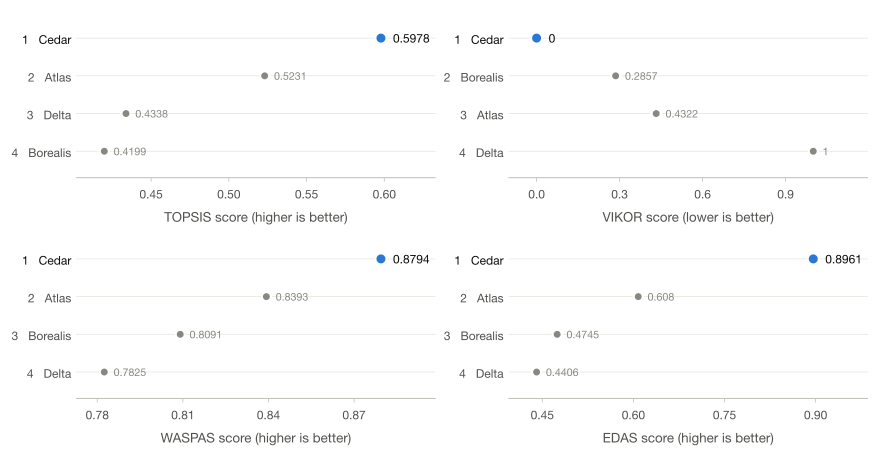
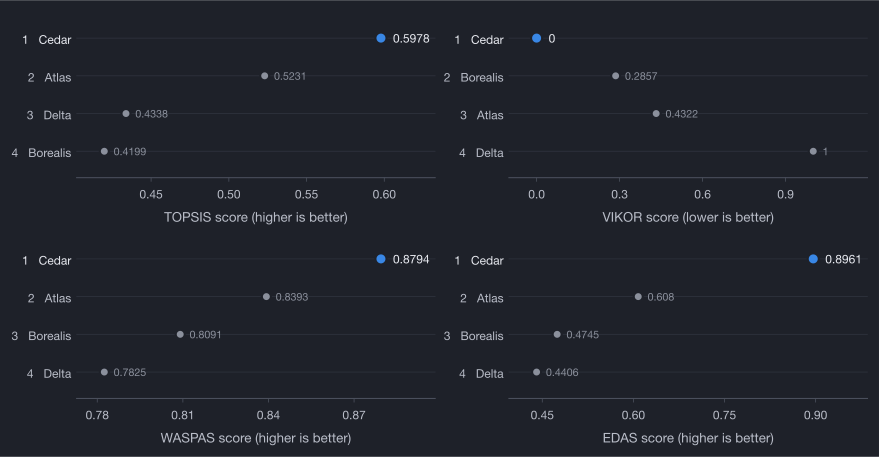
plot.ranking: best at the top, the winner in
the accent colour. All four pick Cedar; VIKOR's scale runs the other way, and
it puts Borealis second where the others put Atlas.Fuzzy ratings: DecisionMatrix and rank_fuzzy
Experts often rate in words. A DecisionMatrix holds
ratings indexed [expert][alternative][criterion], all fuzzy numbers of one kind, with
optional expert_weights summing to 1 (equal weights by default). Build one directly, or
from linguistic terms with
DecisionMatrix.from_terms(scale, alternatives, criteria, terms, expert_weights)
using a LinguisticScale.
rank_fuzzy(matrix, weights, criteria_types, *, method="topsis", aggregation="wa",
ops="algebraic", score=None, **method_kwargs)
then does
three steps:
- Aggregate the experts cell by cell with
aggregate_experts:"wa"(weighted average) or"wg"(weighted geometric mean). - Score each aggregated fuzzy number to a crisp value with its kind's
score(the kind's default, or the name you pass). - Rank the crisp matrix with
method:"topsis","vikor","waspas"or"edas", or one of the six methods of More ranking methods ("codas","copras","marcos","cocoso","wisp","electre"). Extra keywords go to that method (v=,lam=,normalize_weights=).
The operators of the result are those of the crisp method plus aggregation, ops
and score. Because step 2 discards the fuzziness, the method is a convenient way to
use any number kind (triangular, intuitionistic, and so on), not a fuzzy-arithmetic
ranking; for that see Fuzzy TOPSIS.
from bulanik import TFN
from bulanik.mcdm import DecisionMatrix, rank_fuzzy
from bulanik.scales import LinguisticScale

scale = LinguisticScale("demo", {"L": TFN(0, 0, 5), "M": TFN(3, 5, 7), "H": TFN(5, 10, 10)})
dm = DecisionMatrix.from_terms(
    scale, ["A", "B"], ["price", "quality"],
    [[["L", "H"], ["M", "M"]],           # expert 1: rows are alternatives A, B
     [["M", "H"], ["H", "L"]]],          # expert 2
    expert_weights=[0.6, 0.4],
)
print(dm.experts[0][0][0], dm.expert_weights)

r = rank_fuzzy(dm, {"price": 0.4, "quality": 0.6}, ["cost", "benefit"])
print(r.ranking, {k: round(v, 3) for k, v in r.scores.items()})
print(r.operators)
g = rank_fuzzy(dm, [0.4, 0.6], ["cost", "benefit"], method="vikor", aggregation="wg",
               score="graded_mean", v=0.3)
print(g.ranking, g.operators)
TFN(l=0.0, m=0.0, u=5.0) (0.6, 0.4)
('A', 'B') {'A': 1.0, 'B': 0.0}
{'normalization': 'vector', 'distance': 'euclidean', 'aggregation': 'wa', 'ops': 'algebraic', 'score': 'centroid'}
('A', 'B') {'normalization': 'linear_range', 'v': '0.3', 'aggregation': 'wg', 'ops': 'algebraic', 'score': 'graded_mean'}
End to end: words to a ranking
A complete decision, from linguistic judgements to a chart:
- three experts say, in words, how much less important each criterion is than the one before it (price first, then quality, then delivery) as triangular numbers;
aggregate_expertscombines the three opinions into one fuzzy importance per step;swaraturns those into criteria weights (scoring the fuzzy importances with the default centroid);- the same experts rate four suppliers in words, and
rank_fuzzyaggregates, scores and ranks them with the SWARA weights; - the results are plotted.
from bulanik import TFN
from bulanik.aggregate import aggregate_experts
from bulanik.mcdm import DecisionMatrix, rank_fuzzy, swara
from bulanik.scales import LinguisticScale

criteria = ["price", "quality", "delivery"]
types = ["cost", "benefit", "benefit"]
suppliers = ["Atlas", "Borealis", "Cedar", "Delta"]
experts = [0.4, 0.35, 0.25]                       # how much each expert counts

# 1-2. comparative importance of quality vs price and delivery vs quality, in words
importance = LinguisticScale("importance", {
    "slightly": TFN(0.1, 0.2, 0.3), "clearly": TFN(0.3, 0.4, 0.5), "much": TFN(0.5, 0.6, 0.7)})
words = [[["slightly", "clearly"]],               # [expert][one row][step]
         [["clearly", "much"]],
         [["slightly", "much"]]]
steps = aggregate_experts(importance.convert(words), experts)[0]
print("aggregated importances:", [tuple(round(p, 2) for p in (s.l, s.m, s.u)) for s in steps])

# 3. SWARA weights from the fuzzy importances
weights = swara(steps, criteria)
print("weights:", {k: round(v, 3) for k, v in weights.weights.items()}, weights.operators)

# 4. experts rate the suppliers: [expert][supplier][criterion]; "L" price means cheap
rating = LinguisticScale("rating", {
    "VL": TFN(0, 0, 3), "L": TFN(1, 3, 5), "M": TFN(3, 5, 7), "H": TFN(5, 7, 9), "VH": TFN(7, 10, 10)})
terms = [
    [["H", "M", "H"], ["VH", "H", "L"], ["M", "VH", "M"], ["L", "L", "VH"]],
    [["M", "H", "M"], ["H", "M", "L"], ["H", "H", "M"], ["L", "VL", "H"]],
    [["H", "M", "VH"], ["VH", "H", "M"], ["M", "VH", "L"], ["VL", "L", "VH"]],
]
dm = DecisionMatrix.from_terms(rating, suppliers, criteria, terms, experts)
result = rank_fuzzy(dm, weights, types)           # topsis, weighted average, centroid
print(result.ranking)
print({k: round(v, 4) for k, v in result.scores.items()})

# 5. the two charts below come from the same objects
#    from bulanik import plot; plot.weights(weights); plot.ranking(result)
aggregated importances: [(0.17, 0.27, 0.37), (0.42, 0.52, 0.62)]
weights: {'price': 0.434, 'quality': 0.342, 'delivery': 0.225} {'score': 'centroid'}
('Cedar', 'Delta', 'Atlas', 'Borealis')
{'Atlas': 0.4614, 'Borealis': 0.327, 'Cedar': 0.5912, 'Delta': 0.571}
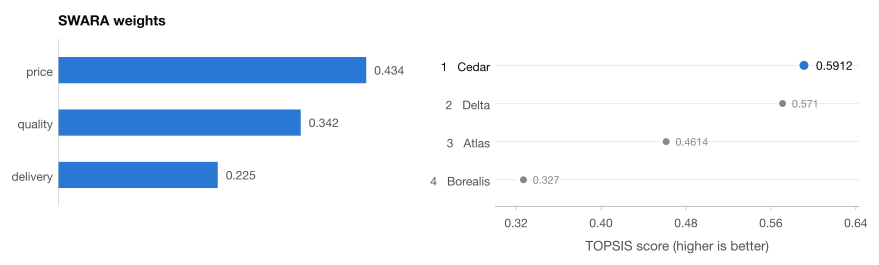
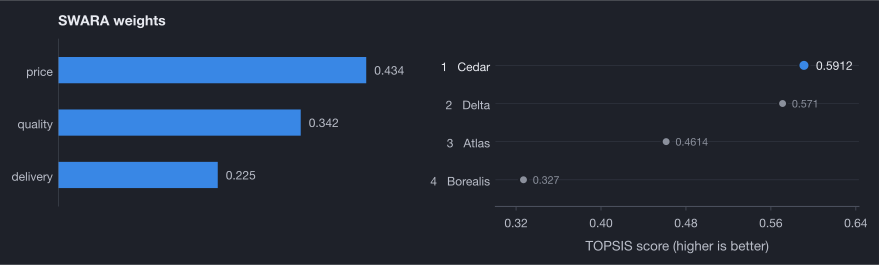
plot.weights (left) and the supplier ranking from
plot.ranking (right). Cedar wins, with Delta close behind.If the decision matters, repeat the last step with method="vikor", "waspas" and
"edas", and with aggregation="wg", and see whether Cedar still wins.
Pitfalls
VIKOR reads the other way. Lower \(Q\) is better. A chart or a sort that assumes
"larger is better" will invert the answer for VIKOR; ranking is always right.
Weights must sum to 1. Otherwise the method raises ValueError; pass
normalize_weights=True for raw importances. Negative weights are always an error.
Mappings and results must match the criteria exactly. A mapping that misses a criterion or has an extra key is an error, so a typo in a name cannot silently drop a criterion.
Cost criteria are "smaller is better", not "negative". Declare them with
"cost"; do not negate the column. WASPAS needs strictly positive entries, EDAS a
positive average per column.
Ties keep input order. Two alternatives with equal scores appear in the order you gave them.
rank_fuzzy throws the fuzziness away at step 2, and different score names can give
different rankings. waspas needs positive scores (for orthopair numbers pass
score="normalized").
Experts must use one number kind. A DecisionMatrix rejects a mix of, say, TFN and
IFN.
from bulanik import IFN, TFN
from bulanik.mcdm import DecisionMatrix, rank_fuzzy, topsis, waspas

def show(make):
    try:
        print(make())
    except Exception as error:
        print(f"{type(error).__name__}: {error}")

data = [[250, 16], [200, 12], [300, 32]]
types = ["cost", "benefit"]
show(lambda: topsis(data, [0.5, 0.6], types))                              # sum is 1.1
show(lambda: topsis(data, {"price": 0.5}, types, criteria=["price", "mem"]))   # missing criterion
show(lambda: topsis(data, {"price": 0.5, "mem": 0.4, "x": 0.1}, types, criteria=["price", "mem"]))
show(lambda: topsis(data, [0.5, 0.5], ["cost", "profit"]))                 # unknown type
show(lambda: topsis(data, [0.5, 0.5], ["cost"]))                           # wrong count
show(lambda: topsis([[1, 2], [3]], [0.5, 0.5], types))                     # ragged
show(lambda: waspas([[0, 2], [3, 4]], [0.5, 0.5], types))                  # a zero entry
show(lambda: rank_fuzzy(DecisionMatrix(["A"], ["c"], [[[TFN(1, 2, 3)]]]), [1.0], ["benefit"], method="ahp"))
show(lambda: DecisionMatrix(["A"], ["c"], [[[TFN(1, 2, 3)]], [[IFN(0.5, 0.4)]]]))
ValueError: weights must sum to 1, got 1.1
ValueError: weights are missing criteria: mem
ValueError: weights name unknown criteria: x; valid: price, mem
ValueError: unknown criterion type 'profit'; valid: benefit, cost
ValueError: expected 2 criteria types, got 1
ValueError: matrix rows must all have the same length
ValueError: WASPAS needs strictly positive entries; for fuzzy scores try score="normalized"
ValueError: unknown method 'ahp' for rank_fuzzy; valid: topsis, vikor, waspas, edas, codas, copras, marcos, cocoso, wisp, electre, fuzzy_codas, fuzzy_waspas, fuzzy_cocoso
TypeError: cannot combine TFN with IFN(q=1)
See also
- More ranking methods for CODAS, COPRAS, MARCOS, CoCoSo, WISP and
ELECTRE, which
rank_fuzzyalso accepts. - Weighting for the weights, and Fuzzy TOPSIS for ranking that keeps the numbers fuzzy.
- Aggregation for
aggregate_experts, Sets and scales for linguistic scales. - LumiX bridge:
scores_as_datahands a ranking to an optimisation model. - API:
bulanik.mcdm,bulanik.plot.ranking. - Examples: 04 SWARA and TOPSIS, 02 scale and experts, 05 intuitionistic pipeline.
- Hwang and Yoon (1981), Multiple Attribute Decision Making, Springer; Opricovic and Tzeng (2004), "Compromise solution by MCDM methods: a comparative analysis of VIKOR and TOPSIS", European Journal of Operational Research 156(2); Zavadskas et al. (2012), "Optimization of weighted aggregated sum product assessment", Elektronika ir Elektrotechnika 122(6); Keshavarz Ghorabaee et al. (2015), "Multi-criteria inventory classification using a new method of evaluation based on distance from average solution (EDAS)", Informatica 26(3).