Sets and scales
Two modules turn words and curves into things you can compute with.
bulanik.setsholds membership functions (a curve \(\mu: \mathbb{R} \to [0, 1]\)), linguistic variables (a named quantity such astemperaturewith termscold,warm,hot), and the fuzzy AND and OR. They are the inputs of fuzzy inference.bulanik.scalesholds linguistic scales: ordered terms mapped to fuzzy numbers, so ratings written as words ("good", "very high") become data for aggregation and MCDM.
The difference: a membership function is a curve over a crisp universe, used when you fuzzify a measurement; a scale term is a single fuzzy number, used when somebody rates something.
Membership functions
Seven factories build a MembershipFunction.
Calling it evaluates the membership of a crisp value; the result is always in
\([0, 1]\), even for huge or infinite arguments.
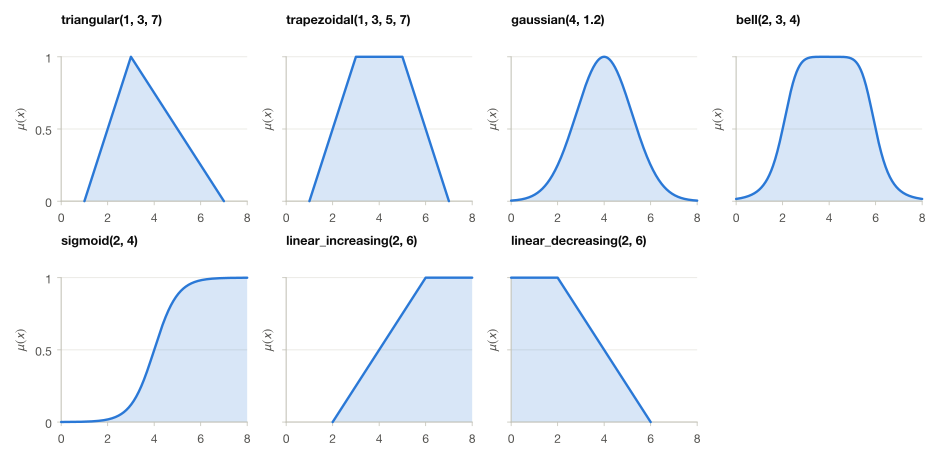
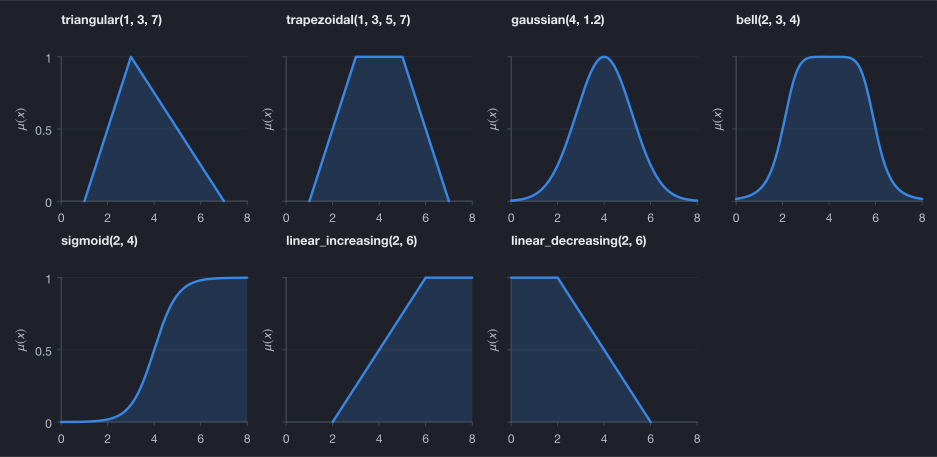
bulanik.plot.variable.| Factory | Parameters | \(\mu(x)\) |
|---|---|---|
triangular |
a, b, c |
rises from 0 at \(a\) to 1 at \(b\), falls to 0 at \(c\) (needs \(a \le b \le c\), \(a < c\)) |
trapezoidal |
a, b, c, d |
rises to 1 at \(b\), 1 on \([b, c]\), falls to 0 at \(d\) (\(a \le b \le c \le d\), \(a < d\)) |
gaussian |
mean, sigma |
\(\exp\!\bigl(-(x - \text{mean})^2 / (2\sigma^2)\bigr)\), \(\sigma > 0\) |
bell |
a, b, c |
\(1 / (1 + \lvert (x - c)/a \rvert^{2b})\), \(a, b > 0\) |
sigmoid |
slope, center |
\(1 / (1 + e^{-\text{slope}\,(x - \text{center})})\), slope \(\ne 0\) |
linear_increasing |
a, b |
0 up to \(a\), 1 from \(b\), linear between (\(a < b\)) |
linear_decreasing |
a, b |
1 up to \(a\), 0 from \(b\), linear between (\(a < b\)) |
A triangle here is a function on a universe; TFN(l, m, u) is a number. They
describe the same shape, and TFN.mu gives the same values, but only the number
supports fuzzy arithmetic.
Three more kinds, gaussian_flat_top, gaussian_min_pair and scaled_triangular,
are building blocks of interval type-2 sets; see Interval type-2.
The monotonic shapes (linear_increasing, linear_decreasing, sigmoid) have an
inverse (\(x\) for a given degree);
for a sigmoid the level is clamped to \([10^{-9}, 1 - 10^{-9}]\) because the curve
never reaches 0 or 1. Triangles, trapezoids, Gaussians and bells are not
monotonic and have none.
from bulanik.sets import (bell, gaussian, linear_increasing, sigmoid,
                          trapezoidal, triangular)

tri = triangular(0, 5, 10)
print(tri(0), tri(2.5), tri(5), tri(7.5), tri(12))
print(trapezoidal(0, 1, 2, 3)(0.5), trapezoidal(0, 1, 2, 3)(1.5))
print(round(gaussian(5, 1)(6), 4), round(bell(2, 4, 6)(7), 4), sigmoid(1, 0)(0))
print(tri.kind, tri.params, tri.is_monotonic)
ramp = linear_increasing(0, 10)
print(ramp.inverse(0.25), ramp(ramp.inverse(0.25)))
print(sigmoid(1, 0).inverse(0.5), sigmoid(1, 0).inverse(1.0) > 20)   # clamped, not infinite
0.0 0.5 1.0 0.5 0.0
0.5 1.0
0.6065 0.9961 0.5
triangular (0.0, 5.0, 10.0) False
2.5 0.25
0.0 True
Linguistic variables
A LinguisticVariable gives a name, a universe
(lo, hi) and named terms. fuzzify(x) returns the membership of a crisp input
in every term; the universe is checked.
from bulanik.sets import LinguisticVariable, linear_decreasing, linear_increasing, triangular

temp = LinguisticVariable("temp", (0, 40), {
    "cold": linear_decreasing(10, 20),
    "warm": triangular(10, 20, 30),
    "hot": linear_increasing(20, 30),
})
print(temp, temp.term_names)
print(temp.fuzzify(15))                 # cold and warm, half each
print(temp.fuzzify(25))
print(temp["warm"](25))                 # one term, as a membership function
LinguisticVariable('temp', (0.0, 40.0), terms=('cold', 'warm', 'hot')) ('cold', 'warm', 'hot')
{'cold': 0.5, 'warm': 0.5, 'hot': 0.0}
{'cold': 0.0, 'warm': 0.5, 'hot': 0.5}
0.5
t-norms and t-conorms
t_norm is the fuzzy AND and
t_conorm the fuzzy OR of two degrees. Two of each exist:
| Function | kind (default first) |
Formula |
|---|---|---|
t_norm(a, b, kind) |
"min", "prod" |
\(\min(a, b)\), \(ab\) |
t_conorm(a, b, kind) |
"max", "probor" |
\(\max(a, b)\), \(a + b - ab\) |
The inference engines use them for AND and OR in rules (options and_method,
or_method; see Mamdani inference).
from bulanik.sets import t_conorm, t_norm

print(t_norm(0.3, 0.6), round(t_norm(0.3, 0.6, "prod"), 4))
print(t_conorm(0.3, 0.6), round(t_conorm(0.3, 0.6, "probor"), 4))
0.3 0.18
0.6 0.72
Linguistic scales
A LinguisticScale maps term names to fuzzy
numbers of one type. Look terms up with scale["term"], test with in, list
with .terms, and convert whole rating tables with
convert, which keeps the nesting of
your lists.
Built-in scales:
| Scale | Type | Terms | Source |
|---|---|---|---|
SAATY_TFN |
TFN |
1, 2, 3, 4, 5, 6, 7, 8, 9 |
Saaty 1980 (crisp 1-9 values); the +/-1 triangular spread is a common convention |
FUZZY_BWM_TFN |
TFN |
EI, WI, FI, VI, AI |
Guo & Zhao 2017, Knowledge-Based Systems 121:23-31 |
EXAMPLE_IFN_5 |
IFN |
VL, L, M, H, VH |
illustrative, no source |
EXAMPLE_IFN_7 |
IFN |
EL, VL, L, M, H, VH, EH |
illustrative, no source |
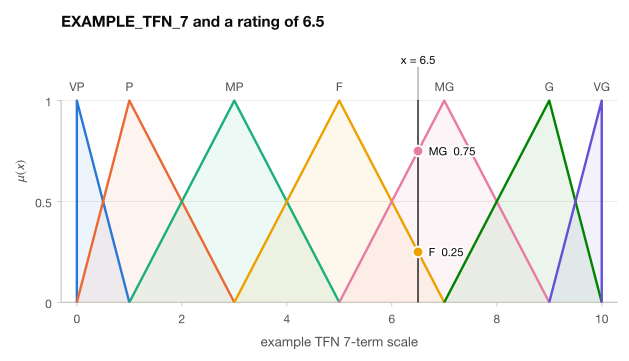
EXAMPLE_TFN_7 |
TFN |
VP, P, MP, F, MG, G, VG |
illustrative, no source |
The three EXAMPLE_* scales are illustrations with made-up values. Use them to
try the library, but define your own scale (or cite a real one) for results you
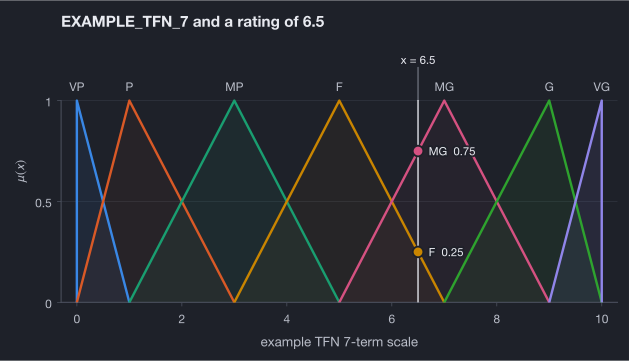
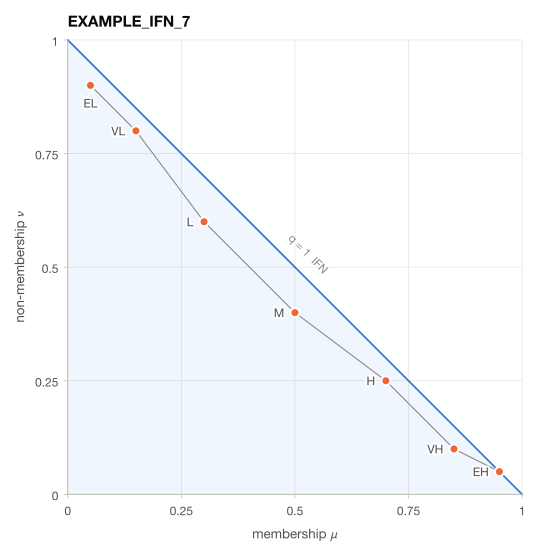
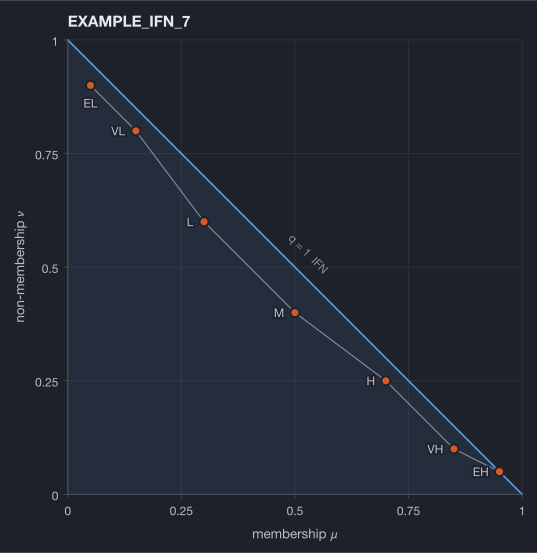
report. The values of EXAMPLE_TFN_7 and of the 7-term IFN scale, drawn:
from bulanik import TFN
from bulanik.scales import EXAMPLE_IFN_5, FUZZY_BWM_TFN, SAATY_TFN, LinguisticScale

print(SAATY_TFN)
print(SAATY_TFN["3"], "3" in SAATY_TFN)
print(SAATY_TFN.reciprocal("3"))               # TFN scales only: 1 / (2, 3, 4)
print(FUZZY_BWM_TFN["WI"])
print(EXAMPLE_IFN_5.convert([["H", "VL"], "M"]))   # any nesting; tuples become lists

mine = LinguisticScale("mine", {"low": TFN(0, 0, 5), "high": TFN(5, 10, 10)},
                       source="my survey")
print(mine.terms, mine.number_type.__name__, mine.source)
LinguisticScale('Saaty 1-9 triangular scale', terms=('1', '2', '3', '4', '5', '6', '7', '8', '9'))
TFN(l=2.0, m=3.0, u=4.0) True
TFN(l=0.25, m=0.3333333333333333, u=0.5)
TFN(l=0.6666666666666666, m=1.0, u=1.5)
[[IFN(mu=0.7, nu=0.2), IFN(mu=0.1, nu=0.8)], IFN(mu=0.5, nu=0.4)]
('low', 'high') TFN my survey
SAATY_TFN is Saaty's 1 to 9 scale (1980) as triangles
\((k - 1, k, k + 1)\) with the ends crisp; the \(\pm 1\) spread is a common
convention, not Saaty's. FUZZY_BWM_TFN is the five-term best-worst scale of Guo
and Zhao (2017).
Pitfalls
Parameters are validated when the function is built, so a bad curve never
exists: wrong order, a non-positive sigma, a zero slope, a wrong parameter
count when you use MembershipFunction directly.
fuzzify stays inside the universe, and a membership function rejects NaN.
inverse needs a monotonic shape.
A scale holds one number type. Mixing TFN and IFN terms raises
TypeError; an empty scale raises ValueError. reciprocal exists for
TFN scales only.
Terms are case-sensitive, and convert rejects anything that is not a string
or a list of them. A missing term raises KeyError that lists the valid ones.
from bulanik import IFN, TFN
from bulanik.scales import EXAMPLE_IFN_5, EXAMPLE_TFN_7, LinguisticScale
from bulanik.sets import (LinguisticVariable, MembershipFunction, gaussian, linear_increasing,
                          sigmoid, t_norm, triangular)

def show(make):
    try:
        print(make())
    except Exception as error:
        print(f"{type(error).__name__}: {error}")

show(lambda: triangular(3, 2, 1))
show(lambda: gaussian(0, 0))
show(lambda: sigmoid(0, 1))
show(lambda: linear_increasing(5, 5))
show(lambda: MembershipFunction("triangular", (0, 1)))
show(lambda: MembershipFunction("hexagonal", (0, 1)))
show(lambda: triangular(0, 1, 2)(float("nan")))
show(lambda: triangular(0, 1, 2).inverse(0.5))
v = LinguisticVariable("service", (0, 10), {"good": triangular(5, 10, 10)})
show(lambda: v.fuzzify(11))
show(lambda: v["bad"])
show(lambda: LinguisticVariable("x", (5, 5), {"a": triangular(0, 1, 2)}))
show(lambda: t_norm(0.3, 1.2))
show(lambda: t_norm(0.3, 0.6, "lukasiewicz"))
show(lambda: LinguisticScale("mixed", {"a": TFN(0, 1, 2), "b": IFN(0.5, 0.4)}))
show(lambda: LinguisticScale("empty", {}))
show(lambda: EXAMPLE_TFN_7["good"])
show(lambda: EXAMPLE_TFN_7.convert(["g"]))
show(lambda: EXAMPLE_TFN_7.convert([5]))
show(lambda: EXAMPLE_IFN_5.reciprocal("H"))
ValueError: triangular needs a <= b <= c and a < c, got (3.0, 2.0, 1.0)
ValueError: gaussian needs sigma > 0, got (0.0, 0.0)
ValueError: sigmoid needs slope != 0, got (0.0, 1.0)
ValueError: linear_increasing needs a < b, got (5.0, 5.0)
ValueError: triangular needs 3 parameters, got 2
ValueError: unknown membership kind 'hexagonal' for MembershipFunction; valid: triangular, trapezoidal, gaussian, bell, sigmoid, linear_increasing, linear_decreasing, gaussian_flat_top, gaussian_min_pair, scaled_triangular
ValueError: x must be a number, got nan
ValueError: inverse needs a monotonic membership function; triangular is not monotonic
ValueError: 'service' input 11 is outside its universe [0, 10]
KeyError: "unknown term 'bad' of 'service'; valid: good"
ValueError: universe of 'x' needs lo < hi, got (5.0, 5.0)
ValueError: t_norm b must be in [0, 1], got 1.2
ValueError: unknown t-norm 'lukasiewicz' for t_norm; valid: min, prod
TypeError: scale 'mixed' mixes number types: IFN, TFN
ValueError: scale 'empty' needs at least one term
KeyError: "unknown term 'good' in scale 'example TFN 7-term scale'; valid: VP, P, MP, F, MG, G, VG"
KeyError: "unknown term 'g' in scale 'example TFN 7-term scale'; valid: VP, P, MP, F, MG, G, VG"
TypeError: expected a term name or a list of them, got int
TypeError: reciprocal needs a TFN scale; 'example IFN 5-term scale' holds IFN
See also
- Mamdani inference and Sugeno and Tsukamoto, which consume linguistic variables.
- Aggregation for what to do with converted ratings, and Triangular numbers for the number types.
- API:
bulanik.sets,bulanik.scales. - Examples: 02 scale and experts, 10 Mamdani tipper.